Showing posts with label BPFTOI. Show all posts

Saturday, October 09, 2010

BPFTOI: Driving Through the Best Years of Miss Daisy's Lives

"Best Pictures From the Outside In" is back. But, oh fiddle, because the series is so infrequent we have to keep explaining it. It's a joint production between Mike at Goatdog's Blog, Nick at Nick's Flick Picks and Nathaniel at The Film Experience. We began in 2008 pairing the most recent winner No Country For Old Men with the first winner Wings and we've been working our way inward ever since from both ends of the Oscar chronology. Get it? Got it? Good. We've now reached 1946 vs. 1989.

 These men have been through enough Daisy. Let Hoke take the wheel!

NATHANIEL: Just when you get used to things a certain way...

Nothing is more certain in life than change so it's something of a human mystery as to why we're always so surprised or discomforted by it. In the Oscar winners The Best Years of Our Lives (1946) and Driving Miss Daisy (1989), we have four protagonists who are dealing with it from the comforts and, this is a fine point, new discomforts of their own homes. When I say "dealing with it" I sometimes mean not dealing with it all. It's a testament to this double feature that there's quite a lot of truth in the coping mechanisms presented, up to and including the coping mechanism of not coping. Sometimes we all just need a little time.

(Oscar sometimes needs a lot of time, which is why he likes to reward social issues movies like Daisy that take place in the rearview mirror.)

Since I mentioned four protagonists, allow me to introduce them. I'm referring to the three World War II veterans Al (Fredric March), Fred (Dana Andrews) and Homer (Harold Russell) who are returning to the homefront in The Best Years of Our Lives and the widowed Jewess (Jessica Tandy) of Driving Miss Daisy who is holed up in her estate when she's suddenly deemed unfit to drive. I stop at four because, Morgan Freeman's Lead Actor nomination aside, I can't buy Miss Daisy's chauffeur as anything like a fifth protagonist. Though he's quite literally driving, he's incongruously but a passenger.

Miss Daisy wants Hoke to drive at the speed of walking but I want the both of you to answer the following question like you've got a lead foot and somewhere else to be. (Let's just get it out of the way and drive on). How offensive (or not) did you find Hoke and/or the movie's complete lack of interest in his story and how much of that was mitigated by the entertainments of Grumpy Old Woman?

MIKE: It's not just uninterested in Hoke's story, it's uninterested in the entire story of the black freedom movement in the three decades after World War II. The only mention we get of anything approaching the Civil Rights Movement is a 1966 speech by Martin Luther King, more than an hour into the film. The only racist violence we hear about is the bombing of a Jewish synagogue. The only racist encounter we see occurs on a trip to Alabama --so I guess Atlanta in the 1960s was a little model of cooperation, as long as the help stayed in the kitchen and didn't grumble under their breaths too much. But there was a TV in that kitchen--surely SOMEONE saw SOMETHING going on that poked a teensy hole in the "slow and steady evens the races" model this film is pushing. And that ending--"You're my best friend, Hoke"--is one of the few times you'll ever see me moved to praise the recent Best Picture winner Crash, because I sort of think Crash knew how ridiculous it was when Sandra Bullock says the same thing to her beleaguered housekeeper. But here in Miss Daisyland, there's no such thing as self-examination. Meanwhile, out in the world, while the Academy was praising carefully crafted, Old Left films about gradual social change, Spike Lee was tossing garbage cans through windows trying to get people's attention. The Academy noticed, of course--the white dude in Do the Right Thing got a Supporting Actor nomination. This film, and this window into the Academy's soul, both make me sick.

 Hollywood Race Relations: Sincere or Ridiculous?

NICK: That's a tough act to follow, so my only option is to surprise even myself by at least playing devil's advocate for Driving Miss Daisy. Just to be clear, I don't think it's a good movie, and along with Field of Dreams and Dead Poets Society, it serves as proof that AMPAS somehow Rip Van Winkle'd its way through one of the stronger years for commercial film in the 1980s. (Then again, the directors and the actors and the writers and the nominators in almost every single category had better ideas than the high-fructose consensus that emerged in Best Picture, so maybe 1989 just proves the liabilities of how the Best Picture slate is determined.) Daisy's images are almost unrelievedly similar and boring. The editor often falls asleep. The score gets hilariously bombastic and misused after that pleasingly shuffle-along title melody. The biggest problem for me is that the script and the direction seem so damned tentative about pressing further into almost any of the story ideas or thematic issues it raises.

But I have to say, on that score, the script doesn't seem inclined to poke around Miss Daisy's backstory or the dilemmas of being Jewish in mid-century Atlanta any more than it wants to poke around Hoke's past or his private life. I don't think she's any more of a "protagonist" than he is, really. When the movie clicks at all - and it does for me, just a little bit, in its closing scenes - it's because I actually do think it hints at the thinness of the bond between these characters, who never know each other very fully even as they gradually feel warmer to each other or get more involved in each other's lives. Daisy's "You're my best friend" is, after all, uttered amid a bout of dementia, and Freeman doesn't imply that Hoke agrees here at all. The golden close-up on their clasped hands is a bit much. But almost immediately Daisy cuts to a very dark long-shot unlike almost anything else in the movie, which makes Daisy herself and this plaintive exchange both look awfully feeble and cold.

NATHANIEL: Well, when your only other option for Best Friendship is your obtuse son with the wandering suthehn accent and your silent housekeeper, isn't chatty Hoke a good option? At least he'll laugh at your jokes.

NICK:  That generous sense of humor helps this movie a lot. It's one of the hundred or so ways in which Freeman manages to bat back at the cloying and insulting potentials in this script and make Hoke (for me) an intriguing, legitimate character. In terms of what Mike pointed out, I do also appreciate that quick, earlier moment when he rebuked Daisy's idea that race relations were "totally changing" in the era of King.

MIKE:  I totally agree that there should be more to this discussion than just DMD's racial politics, but I keep getting dragged back--Hoke's sense of humor reminds me of the skit in the middle of Public Enemy's "Burn Hollywood Burn" about the casting director looking for a black actor willing to play a "controversial" character (a butler who chuckles under his breath). But you were saying.

NICK: I do agree it's demented to vote this Best Picture, and a particular slap in the face in the year of Do the Right Thing (or Crimes and Misdemeanors, or When Harry Met Sally..., or Roger & Me). But I think the movie finally shows at least some sobriety and tact about exactly what kind of relationship these two have. I don't think Daisy does a very good job even at being the basically safe movie it is, but I don't know that it's fair to ask it to be Do the Right Thing, either. I'm much more annoyed by movies of this era like Mississippi Burning, which styles itself as exactly the kind of bold, historically minded, race-focused protest picture you want Daisy to be and actually distorts the record and omits black perspectives even more than Daisy does.

 "Well, I'll be. We got 9 nominations and 4 Oscars! Do The Right Thing went 0 for 2"
That Hoke... such a kidder. Wait, that was a joke, right? That didn't actu ---oh god.

NATHANIEL: I'd actually love to excuse the Academy's love of this whole mini genre of minority struggle narratives coopted to tell stories of tolerant white people (see also the previous Best Picture's episode!) as dementia. At least then, they'd have an excuse. But it's a wider problem than just Oscar taste level. Critics, media and audiences tend to embrace these films in large numbers, too.

MIKE:  OK, off the topic of racial politics, there are some things I like about this film. That snappy little jingle that pops up in the score when it's not being bombastic is tops for me. I think I like Hoke, mostly because of the gravitas Freeman brings to the character, which keeps him from drowning in the script. The glowing cinematography got old, but there's some darkness that verges on the wildly experimental, given the film's overall conservativeness: that weird "oh my god look at all our reflections in the mirror" bit during Tandy's first "spell" seems like it's dropped in from a different film, but the long, dark shot at the end that Nick mentioned is a sobering way to close things. And I sort of like Dan Aykroyd, despite the wandering accent, for his genial longsufferingness. As for Jessica Tandy, I couldn't really separate her performance from the film: it seemed like one of those "oh no this old lady's gonna die soon" awards that happened a few times (some deserved, some not) in the 1980s.

NATHANIEL: You know how difficult it is for me to praise Jessica Tandy here (given the Oscar tragedy that played out... that unspeakable tragedy that I'm always speaking about) but I do think she does fairly good work with the innocuous material. Not Oscar nomination worthy good but good all the same. I like that you can see cracks growing in her "I'm not prejudice" mantra. She's not exactly self aware but she's not exactly not either and you can see that this annoys her more than it moves her towards actual change or self examination. That feels, to me, like a cool acknowledgement of the way people often process their own failings.

And this movie can take any tiny cold snap anyone can gift it with. The cinematography was so golden soft that I felt it was constantly trying to tuck me in for bed with a very warm blanket or roll me right up into a papoose so that I'd never have to feel anything uncomfortable or chilly ever again.

But I like the chill since it helps me appreciate the warmth.

War heroes in the round: The Airman, The Soldier and The Sailor return home.

Speaking of which, how about the versatile cinematography and shot composition in The Best Years of Our Lives? I swear to god... it was like entire miniature movies in every scene. Warmth and chill and other glorious complements everywhere I looked.

NICK:  Totally! The approach to lensing, shot structure, and editing in The Best Years of Our Lives is just so inspiring. I remember being not prepared at all when I first saw the movie, because I wasn't used to looking for technical virtuosity or intense formal variety in projects that look on the surface like unpretentious domestic soapers. This is the kind of movie that Hollywood so often shoots so boringly--relying entirely on actors to drive home all the emotional beats in the script, as though trying to convey feeling through focus, camera movement, lighting contrasts, or whatever would somehow undercut those emotions. Which is funny, because just within this series, William Wyler's own Mrs. Miniver seems like a good example (as, frankly, does Driving Miss Daisy) of exactly that sort of punch-pulling movie. Still within this series, though it's nothing like The Best Years of Our Lives, American Beauty was another example that if you explore middle-class domesticity with formal flair and visual invention, the ticket-buying populace really can get excited about it.

 William Wyler in the 1940s. Did any director ever have a decade this good?
6 Features | 2 Best Pic & Dir. Winners | 3 Best Pic & Dir. Nominees |
1940s Haul for Wyler Features: 47 nominations | 18 wins
| 1 Honorary

I don't absolutely adore Best Years the way I did on first pass, but if you compare it to the chilly, self-conscious formalism of Wyler's Little Foxes in '41 or the unambitious warmth of Mrs. Miniver in '42, it's just amazing that he's able to rifle through his entire bag of technical gambits and still make the Derrys and the Stephensons and the Camerons and the Parrishes at least as dear to us as the Minivers were. More so, really.

MIKE:  I'm with you guys 100%, except the part where Nick doesn't absolutely adore Best Years like he did on first pass, because I think I love it even more this time around. It vaults into my handful of best Best Picture winners ever (which might seem like damning with faint praise). What jumped out to me most this time around was Gregg Toland's use of deep focus, which he had knocked out of the park a few years earlier in Citizen Kane. He uses it with such versatility here, and it's amazing how many different things it can do depending on the context of the scene. My two favorites were (1) the barroom scene where Harold Russell and Hoagy Carmichael were playing the piano in the foreground, Fredric March was nervously in the middle ground, turning from the piano to the far, far distant background where Dana Andrews is giving Teresa Wright the heave-ho via telephone. It's like there's a million miles between them! And (2) the wedding scene (which still makes me cry) with Andrews's face in the foreground, the happy couple in the middle, and an angelic-looking Wright in the background. Here, the focus pulls everyone together, emphasizing their closeness.

One filmmaking technique = Two entirely different feelings.

And I love your "unpretentious domestic soaper" line, Nick, because the film does feel episodic. You could "tune in" for a couple of scenes and then go do your laundry, then come back and watch a different section of the movie. Not many films feel like they can work as a whole or as bite-sized, but still self-contained, chunks. And even though it's following more than a half-dozen characters, it manages to make them more fully formed than Daisy did with three. (And the extended running time only partly explains that.) Who's your favorite? Mine is Dana Andrews's Fred, who uses Andrews's unique bruised masculinity better than any of his other performances.

NATHANIEL: Hear hear on Dana Andrews. His performance felt like a marvel of internal distress signals to me... which made his inappropriate romance with Teresa Wright so relatable; she was tuned to his frequency. Her erotic attachment to him is not as simple as "I can save him" but that element is definitely there. Fortunately, despite all the potential cliches this team is working with I feel like they just nail down the core truths of certain familiar tropes with such precision and force. One scene that really knocked me over with its expressiveness in both performance and direction -- all the filmmaking tools Nick mentioned -- was Dana's solo moment in the cockpit where he lets himself access the war memories he's been keeping at bay. I found it to be such a beautifully judged emotional climax but used as transition into the last sequences where the storylines thread back together for the wedding.

 This cockpit has seen heavy fire; this pilot is all burned out.

You know, I think today's audiences (and I'd include myself here) are missing out whenever they dismiss earlier entertainments as "simpler times". Just because the movies didn't have body counts, profanity or sex scenes, doesn't mean they weren't extremely adult in tone. In fact, it's tough for me to even imagine a modern war drama delving this deep into both interpersonal connections and abcesses. You mentioned the movie's episodic nature and maybe that's why it plays out with such modernity to me. I felt like I was watching a lost Emmy-winning series from HBO or AMC had either been around in 1946. There are just so many through lines and longform dramatic beats in the screenplay.

My least favorite of the film's three threads is Harold Russell's. It wasn't because his scenes weren't moving so much as they didn't transcend their romantic drama / war film templates as well as the other two stories did. Aside from Dana Andrews, my favorite star turn belonged to Myrna Loy. She works absolute magic in her wifely duties both to Fredric March and to the picture itself, keeping so many scenes grounded with pragmatism, patience and a lived-in resiliency. Loy gives you a real sense of both what her character was like as a wife before the war and how the war changed her even from the peaceful homefront. But despite her realistically portrayed wariness and annoyance at some of the life changes on the way, she's such a comforting grounded presence that you know her husband (and the larger movie) will be able to work through his post-traumatic stress issues and readjust as best he possibly can to civilian life.

NICK:  Agreed on Andrews: so great at charting implosive feelings, right before that became the sole province of neurotic Method tics. Agreed on Loy, whose taking-in-stride of her husband's embarrassing bender is played so simply, but is so modulated and complex. I like Wright slightly less than these two, but I like her for all the reasons Nathaniel cites. That none of these three got Oscar noms despite the juggernaut status of the film is too bad. I'm sure Andrews is too "quiet" for AMPAS tastes, and I wonder if the studio deferred to March's star power by putting all their push behind him. There could well have been category confusion about the women, but honestly. They nominated Jennifer Jones for playing a tempestuous Tex-Mex and Flora Robson for glowering in blackface. Blackface!

Fredric March is one of my favorite actors, and I have plenty of glowing things to say about him, too. I'll leave myself to one, since it overlaps with Wyler's staging idea: the famous moment when he returns home and each family member discovers his presence, one by one. Everyone's great in this scene, which uses depth of field so conspicuously you can feel the "staginess" despite the marvelous emotion that still pours out of this reunion. And I think March brilliantly accounts for some of the "staged" quality of the filmmaking into his psychological profile of the character. Al clearly likes the idea of a Heartwarming Reunion, and it's not as though he's at all insincere. But as poignant as the moment is, you see how quickly he realizes he's not ready for all this, and kind of wants to be left alone. Tearful embraces are great, but they don't tell the whole truth.

 We've got choreography! A beautifully "staged" family reunion.

I don't think all of Wyler's ideas work so perfectly or integrate themselves so well. If there's anything to be said against the movie for me, it's that you almost hear Wyler and his team figuring out what nifty lensing or staging conceit they want to try out now. It's like the directing version of Kael's notorious anti-Streep comment: click, click, click... And, way too many times, the "big idea" they bring to Harold Russell's scenes is, "Let's make the audience patiently watch while he does something in real time that you'd imagine a man with no hands could not do."

Still, the film is so obviously humane and, in ways that count, emotionally restrained enough that it never feels exploitative of Russell, or of anyone else. And I totally agree that the whole movie is a remarkably rangy, sobering, and novelistic experience. I second (or third?) every lovely thing you guys have said about it.

NATHANIEL: Novelistic is right which is why this movie could easily provoke a week's worth of conversation... but we have to draw the line somewhere.

Am I correct in assuming we all think the Homer (Harold Russell) third is the film's least effective? As someone who generally distrusts sentiment in movies (I often feel like it amounts to emotional pornography, all mechanics with manufactured emotions) I was surprised how well these scenes did work for me. And I think it's for the reasons you've stated. Yes, it's a little obvious but I admire that Wyler is willing to put us in an uncomfortable place as an audience on his way to more traditional movie warmth. More than once the audience awkwardly shares the wary emotional POV of Homer's fiance's parents. We're forced to gawk and even though our hearts are telling us this is an incompassionate place to be, you do have to wonder if you'd want that caretaker life for your daughter.

Just discussing this movie makes me want to dive back in right now. It totally earns its sentiment and that's a rare achievement.

MIKE:  Looking back over fifty years, Harold Russell’s story is the least effective, for the reasons Nick mentioned—the goal here was to have a heart-to-heart with American audiences who were going to have to get used to seeing that kind of thing, and to remind them of the sacrifices people made in the war. It’s certainly part of the overall message of the film, that war is not necessarily glorious, it messes people up both physically and emotionally, and it might make your husband/boyfriend/son seem like a stranger. But we don’t need that patient semi-lecture today; we’ve seen Platoon and Saving Private Ryan and countless other films that take that as a given. So Russell’s story is where the film seems too message-y (although I absolutely LOVE how Toland shoots his house), and it lacks the acting firepower of the other storylines, and it is too occupied with that “this is how you take off your pants if you don’t have hands” pseudo-documentary feel. But Russell’s story gave us those wonderful scenes in Hoagy Carmichael’s bar, which rank among my favorites in the movie. So there you go.

 You hardly recognize them. They hardly recognize themselves.

The absence of that “we have some tough things to tell you” attitude was what irked me the most about Driving Miss Daisy, which wanted it both ways—it’s a loving paean to a way of life that’s long since disappeared, but it’s also a (spineless) criticism of that way of life. Best Years shows us that you can demonstrate your love for small-town America while still taking it firmly to task for being bigoted, or unthinking, or unappreciative. To do it mostly without preaching is a little miracle.

Of course, next time around we’ll have preaching up to our armpits, as Elia Kazan and company grab us by the scruffs of our neck and teach us a lesson about anti-Semitism in Gentleman’s Agreement; it will
be paired with one of the weirdest Best Picture choices of all time, Rain Man, and I can only imagine how we’ll pine for the warmth and complexity of Best Years of Our Lives as we give each other those baffled but affectionate looks that Morgan Freeman kept giving Jessica Tandy. Oscars. There’s lots of them.
 Miss Daisy stubbornly insists on walking to the video store to rent Rain
Man
and Gentleman's Agreement. She doesn't know from Netflix.


NATHANIEL: Readers, back to you. Chime in!

for a complete index of this series thus far, click here.
*

Tuesday, September 07, 2010

Best Pictures From the Outside In

Have you seen all of the Best Picture winners over the years? I'm nearing my personal finish line. (Mea culpa. 5 remain unseen: Gentlemen's Agreement, Hamlet, A Man For All Seasons, The French Connection and *gulp* The Godfather Part II. I am deeply ashamed) If you're semi-new to The Film Experience, check out this tri-blog series wherein Nick, Mike and Nathaniel (c'est moi), rescreen the winners starting from both ends of Oscar's chronologally. (We began in 2008 which is why Slumdog Millionaire and The Hurt Locker do not kick the festivities off)

Best Pictures From the Outside In (so far)
episode 1 No Country For Old Men (07) and Wings (27/28)
episode 2
The Departed (06) and Broadway Melody (28/29)
episode 3 Crash (05) and All Quiet on the Western Front (29/30)
episode 4
Million Dollar Baby (04) and Cimarron (30/31)
episode 5
LotR: The Return of the King (03) and Grand Hotel (31/32)


episode 6
Chicago (02) and Cavalcade (32/33)
episode 7 A Beautiful Mind (01) and It Happened One Night (34)
episode 8 Gladiator (00) and Mutiny on the Bounty (35)
episode 9 American Beauty (99) and The Great Ziegfeld (36)
episode 10 Shakespeare in Love (98) and The Life of Emile Zola (37)

episode 11 Titanic (97) and You Can't Take it With You (38)
episode 12 The English Patient (96) and Gone With the Wind (39)
episode 13 Braveheart (95) and Rebecca (40)
episode 14 Forrest Gump (94) and How Green Was My Valley (41)
episode 15 Schindler's List (93) and Mrs. Miniver (42)


episode 16 Unforgiven (92) and Casablanca (43)
episode 17 Silence of the Lambs (91) and Going My Way (44)
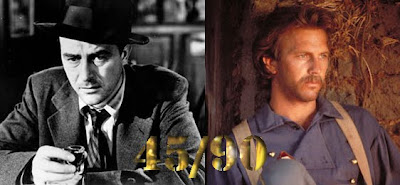
episode 18 Dances with Wolves (90) and The Lost Weekend (45)

COMING VERY SOON
Driving Miss Daisy (89) and The Best Years of Our Lives (46)
*

Tuesday, June 29, 2010

Best Pictures: Dances With Wolves & The Lost Weekend

It's been nearly six months since the last episode of the tri-blog series Best Pictures From the Outside In. At this rate we'll be done in 2021! Literally. "Stay tuned!!!" Nevertheless we're finally back with a new installment pairing 1990's Dances With Wolves & 1945's The Lost Weekend.

and comment on that discussion there.

Since those conversations are rarely about the Oscar field but just the winners, I thought I'd share a few quick words on 1990 and 1945 right here. I've noticed in my own lists over the years that the further back in time I go the more I agree with Oscar's choices. I'm guessing this is not a case of Oscar once having better taste (i.e. mine - haha) but simple math. I've seen more films from the modern era so the chance of disagreeing grows. For instance, Oscar's best picture field for 1990 was composed of...
  • Awakenings
  • Dances With Wolves
  • Ghost
  • The Godfather Part III
  • Goodfellas
Which was almost nothing like my list at the time (though I hadn't seen Goodfellas) which went like so back in the day...
  • Edward Scissorhands *winner*
  • Ghost
  • The Grifters
  • Longtime Companion
  • Postcards From the Edge
I'm not sure I could stand by the Ghost cheese 20 years later or Longtime Companion (I don't remember it well) but the other three have had staying power in my brain and in movie culture, too.

My decrepit ancient copy of Inside Oscar is filled with color markings -- I once used the book to track my film viewing. Certain years have highlight markings all over the film titles. The 40s are my weakest decade but strangely 1945 is all marked up. I'd rank the Best Picture nominees like so
  1. Mildred Pierce (Such a goodie. Watch it before the Kate Winslet remake arrives)
  2. Spellbound
  3. Anchors Aweigh
  4. The Lost Weekend
  5. The Bells of St. Marys (the first sequel nominated for Best Picture and the only BP nominee from '45 that I haven't seen. But I didn't really care for Going My Way so I'm in no rush)
I love those first three so I'm fine with Oscar's list. But is that because I've seen so little else from '45? I wonder, if I saw 100 films from each film year before my time, would my taste rarely align with Oscar's? Have you ever wondered about the same thing? A "yes" answer means hidden gems and new favorites await you in every single film year should you only start to look for them.

Now, read our boozy bender with Kevin Costner over at Nick's Flick Picks.
*
*

Friday, January 15, 2010

BPFTOI: 1944 & 1991

It's time for another installment of the "Best Pictures From the Outside In" series. Mike, Nick and I have been having these mash-up conversations off and on for what seems like forever and we're only 17 episodes in! I don't want to sound like I'm bemoaning how long we have to go... just that it's taken us so long that soon we'll have not just one (Slumdog Millionaire) but two (Up in Avatar's Inglourious Locker?) "Best Pictures" screwing up the concept of our original bookend timeline mashups. Anyway, I'm not complaining. I love the refreshers in Oscar history and the opportunity this affords me to see some films for the first time. I'd never actually seen the 1944 winner Going My Way, starring Bing Crosby as a saintly singing Irish priest and this was my first chance to revisit Silence of the Lambs on Blu-Ray.

'44 nominees: Double Indemnity, Gaslight, Going My Way & Since You
Went Away
. Wilson, the fifth, is largely forgotten. No poster online (!)

1991 nominees: Beauty & The Beast, Bugsy, JFK, The Prince of Tides and
The Silence of the Lambs (an anomaly in Oscar history)

History has a way of proving Oscar wrong (Double Indemnity is the film that people still worship from 1944) and proving them right (many people thought Silence was an instant classic in 1991 ... and they were correct). At the time of the 1991 Oscar race I was personally rooting for Beauty & The Beast but since I knew it wouldn't win, I was pulling for Beatty & The Bening... yes, my obsession with those two goes way back. In retrospect it's so exciting that Silence won. It's the only horror movie to have ever garnered the industry's top prize unless you count Hitchcock's Rebecca (do you?) or Forrest Gump (kidding!)

Since I've been spending this week preparing for my own FB Awards, I'm kinda focused on my own personal favorites at the moment. If I had always ruled the world the 1944/1991 conversation would be a match made in girlie heaven, Meet Me in St Louis and Thelma & Louise, both of which are in my personal canon. Strangely both were snubbed for Best Picture by the Academy despite strong public and critical reception and a multiple other nominations, too: Thelma won six nominations and St. Louis four.

Nathaniel's 1991 & 1944 favorites

Anywayyyyyyy. My point is that that paired conversation would be a helluva lot different than the one we just had involving leering cannibals and celibate priests.

read and join the conversation @ Goatdog's Blog.
Comment over there. Mike won't bite. That's Dr. Lecter's bag
*
previous episode: Unforgiven (1990) and Casablanca (1943)
coming in February: Dances w/ Wolves (1990) and The Lost Weekend (1945)
full index of episodes

Tuesday, December 29, 2009

Best Pictures... "Play it Again, Clint"

Nathaniel: Once again we apologize for the long delays between episodes. This Best Picture From the Outside In series… it’s a helluva thing.

1928----1943------------------------1992-----2007

We continue to pull one movie from either end of Oscar’s chronology, working towards the center of their eighty-plus year history. This match up brings us two of Oscar’s most respected prize-winners: Casablanca (1943) and Unforgiven (1992). Both films essentially begin with a sudden eruption of violence (a shooting and a slashing, respectively) followed by the intervention of local law enforcement (embodied by Claude Rains and Gene Hackman, respectively). World War II era Morocco and Wild West era Wyoming are dangerous and morally ambiguous places. They're also fine places to escape from one's past and start anew. At least that's how Rick Blaine (Humphrey Bogart) and William Munny (Clint Eastwood) see it.

Casablanca and Unforgiven toss out key plot points and introduce multiple supporting players before they get to Bogie and Clint, their twin heavyweight champions of American masculinity. It’s almost as if the stories have to spin madly from the start to create enough centripetal force to yank these two self-contained icons away from their isolation and pull them into the action.

I appreciate Clint's deconstruction of his own mythology through William Munny in Unforgiven but in the end I think he can't get enough distance from it. He is that He is as it were. Casablanca, on the other hand, benefits enormously from the distance that its director Michael Curtiz has while he gazes at his star. Rick's reluctance to star in his own movie, Casablanca, remains wonderfully fascinating. What's more I love the incongruous artistic friction between Rick's job as host of the party (Everybody Goes to Rick's was the original title of the movie) and his actual personality as displayed throughout the movie (bitter, unknowable and more than a little self-pitying) which never seem to jibe. Casablanca remains unbeatably gripping, especially once Ilsa (Ingrid Bergman) has entered the film. The western is trickier to ride with as it run in circles and occassionally veers toward great scenes. I love Unforgiven's thematic gravitas but I always feel like it's a sell out in the end, backing away from its disturbingly sober guilt to engage in old fashioned consequence-free blood spilling.

But I'm jumping too far ahead. Back to the beginning... when did you know that you loved these movies? Or if you didn't love them (gasp), where did they lose you?

Mike: Unforgiven had me with its opening crawl, about a mother's dismay that her only daughter would marry "a man of notoriously vicious and intemperate disposition," rolling over a lonely shot, mostly silhouettes, of a man burying his wife. There's that distance you mentioned, and it crops up again and again throughout the film in super-wide establishing shots and full-body long shots. It's also there in the self-consciously artificial eloquence of the crawl and of much of the dialog; later, Little Bill will ridicule the writing of Saul Rubinek's scribe (a mirror, perhaps, of piano-playing Sam in Casablanca?), but he doesn't notice that he tends to talk like he's in a penny dreadful.

Casablanca also had me from its opening, with the staccato narration about how people come to Casablanca "to wait... and wait... and wait," followed by that amazing shot of one of the usual suspects shot to death against a huge poster of Marshal Petain, and then the amusing interlude with the pickpocket advising some unsuspecting victims to beware of people exactly like him. It's that combination of dead-serious drama, somewhat overwrought melodrama, and diverting comedy that makes the film for me: it has all the elements of a typical Hollywood production, but it all comes together in a magical, perfect film.


Nick: At no point have I known that I loved Unforgiven, though I admire parts of it very much and think it's an exceedingly handsome film much of the time. And "thematic gravitas" pretty much hits the nail on its big cardinal virtue, give or take the way in which the framings and shot sequences often do look beneath the brooding 90s cinematography as though the movie were made four decades earlier, like Sam Fuller or somebody making a nasty double-biller for The Searchers. (You can certainly imagine Fuller opening a movie with this ghastly, misogynist violence, though his approach would have been even less timid.)

But I'm going to disproportionately focus on my misgivings, because the film's reputation always strikes me as excessive to its strengths. I agree with Nathaniel that Clint never manages enough distance from his own iconicity, partly because his acting feels so inadequate to the task. I rarely feel, despite the curdled force of the filmmaking in William Munny's two encounters with Gene Hackman's Bill Daggett, that this character has really transcended a past life of odious heartlessness, or that he's been pulled fully back in, or that it was all that difficult for him to get pulled back in, if that's what's happened. For sure the film's essay about corrosive violence works, but I just don't buy the arc it's supposed to have. At times, Eastwood's line readings border on the disastrous, but even when he's solid, he's often a mouthpiece for the film's assertions about William Munny while actually embodying someone too much like Clint Eastwood, and blurrily so: waffling between the aloofness of his most famous characterizations and the grotty naturalism that the script seems to require.

On that point, I've gotta add that, Hackman's Oscar notwithstanding, the unevenness of the film's other performances - a chronic problem in better and worse Eastwood pictures - limits the power of this one. And as marvelously as the film resuscitates a late 40s / mid 50s shooting and editing style, I often feel (as I do not in Million Dollar Baby) that the film sticks itself with unnecessary shots and some repetitive scenes, especially as Eastwood, Freeman, and Woolvert make their way to Big Whiskey. A lot of people lionize the "classical" filmmaking as though it's automatically tremendously succinct and disciplined, or vindicated in every respect by relations to past masters, and I just don't think it always is.

Mike: Just nudging back in: I think the film's uncertainty about whether Munny's transcended his past life of odious heartlessness is the point, and Munny shares that uncertainty; his constant "I've changed! I've changed! I'm not like that!" is a bit of a Munny doth protest too much. He's trying to convince himself and everyone around him, but I never really buy it: he's always full of fear of himself; he knows what kind of person he is, even if he doesn't want to be that person. He knows that all it will take is a little too much to drink or an encounter with someone who doesn't believe his protestations to let everything loose again. He's like a guy who joined a monastery disguised as a pig farm to hide from his addiction to chaos, and his incessant talk about dear departed Claudia is like a repetitive recitation of the rosary. I think that's why the super-Munny who emerges during the shootout at the end didn't throw me very much, because I saw that underneath the surface the whole time.

Humble Pig Farmer or No Good Killer?

Nick: Whereas I believe Eastwood's projection of what Munny "really is" only marginally more than his borderline-amateurish performance as Munny the pig farmer (which is too clumsy to me to work as a reflection of Munny's own ill-suitedness to that task). Beyond a few choice shots and moments, I don't feel the odious heartlessness, the addiction to chaos, the super-Munny, or the desperate self-convincing. I absolutely agree with you that the script works exactly as you say, but what all the moody sepia underlighting in the world and all the stark silhouettes against a tub-colored sky can't do (for me), and what Eastwood's acting wholly fails to do, is to put real conviction and emotional plausibility into the admirably ambitious, tragic pitch of these character beats. I actually buy Frankie's soul sickness and sour temper in Million Dollar Baby much more than what's going on with Munny... and speaking of protesting too much, I worry that in stacking so many chips in the square of Munny As Tragic Figure and Story As Morality Parable, the film almost totally misses the more immediate premise, swatted right in the character's name, that he's doing all this because he flat needs the cash.

Break the tie, Nathaniel!

Nathaniel: Unnhhh....I realize you're pushing your reservations to the forefront rather than focusing on what you do love about it, just for conversation's sake. But if I'm breaking a tie it doesn't come down in the movie's favor. BUT I mostly like the movie I should quickly add, for fear that it's über fans come at me with guns a blazin.

I love Mike's assertion that the monster is always still lurking and the man doth protest too much but I hadn't realized until reading your objections Nick, that what was missing for me was that kind of spine-tingling amorality/savagery that suddenly makes you uncomfortable with your pre-existing love for the iconic star you've come to see: I'm thinking of a couple of Daniel Day-Lewis moments in There Will be Blood or that beating scene in Bugsy where the otherwise charming and suave Warren Beatty suddenly seems considerably less human while shouting at a victim with blood streaming down his face. (Remember that?)

I also think the bookend scrawls spoil it. That is so hedging your bets. Especially with the sunset. It's as if Unforgiven knows that deep down it is a super impressively disturbing movie but it doesn't want to offend anyone who might need more in the way of catharsis and redemption or don't want to worry so much about how much they enjoy watching Clint Eastwood kill people. I guess I wanted more in the performance and in the movie that was tough to stomach. No pun intended but I'm thinking of the scene where the guy gets shot in his. You just have to deal with his howling and his bleeding and his terror about dying while everyone else in the scene is reduced to the uncomfortable act of seeing and hearing him expire. Great stuff.

Nick: The toughest thing for me to stomach in the movie is the scene where Eastwood, still a stranger in Big Whiskey, is so pitifully hunched under his hat in the bar, and Hackman is goading him for his firearms and fixing to show him some Daggett-style justice. There's something bracing about the scene's stress on Daggett's absolutism and about the way the shots, the edits, and Eastwood's body evoke how coiled up, angry, ambivalent, and outmatched Munny is in this moment. I wish the opening assault on Delilah resonated quite this much, or Ned's apprehension and murder, but the sloppy casting and directing of the women keeps slaking the force of the outraged-women plotline. Frankly, I worry that the film can't think or feel its way all the way these crimes; it uses them too much as plot devices that get a little overwhelmed by the thick, heavy atmosphere, and it verges on a cynical use of victimized women and a somewhat timidly coded lynching as another one of those crutches on which rests the re-emergence of Eastwood the Avenger that worries Nathaniel at the end.

I'm totally leaving it up to you to trust that I like this film much more than I'm admitting, but I find its flaws almost as galling as its almost instant canonization. I'll happily concede that the
acerbic challenges to Western mythology in the Hackman/Rubinek scenes almost works better for me than some of the foreground Will Munny stuff, and it's a much more engrossing second-tier storyline than I had remembered.

Whereas the 'second-tier' stuff in Casablanca is not only perfectly matched to the headlining relationship between Rick and Ilsa, but I can barely find a single thing in the movie that isn't enriched by its connections to everything else in the movie.

Nathaniel: Absolutely. I suffer forgetfulness when it comes to Casablanca, which turns out to be a blessing in disguise; every time I've seen the movie it's like my first screening of it. The thing that struck me most this time was, in fact, the secondary elements and how they reflect back on and complicate the main triangle of Rick, Ilsa and Victor. Like the young couple I had completely forgotten about, the impoverished Bulgarians.

Should the Mrs. sleep with Renault (Claude Rains) to get exit visas and hide it from the Mr. forever? Posing this indelicate question to Rick, he is brusque and judgmental 'Go back to Bulgaria'.

Nick: He is incredibly peremptory, occasionally even cruel, for a protagonist we are obviously meant to admire. And it’s not as though Bogie is downplaying Rick’s unpleasant qualities, which is impressive in and of itself. But you were saying…

Nathaniel: ...that just as soon as he's bolted from all that projected sexual guilt and marital protectiveness, he's confronted with Ilsa and Rick, reentering his club. He rudely reminds Ilsa of her own hidden indiscretions with a reference to Paris and then he's bolting out of there too and back to the Bulgarians to do what amounts to a good dead. And then he's off again, (this movie is as restless as Rick himself) this time colliding with Renault, the villain in this particular scenario. But, that's so murky, because the movie is continually asking us to equate Rick with Renault (in spirit if not in temperament) each of them reigning over their own amoral fiefdoms.

Now, the situations and the characters are not at all perfect mirrors of one another (which is how clumsier movies often aim for this same effect) but we're still talking about a man of questionable motives confronted with a sexual triangle that casts a possibly harsh light on his own feelings in the other sexual triangle in which a woman has been unfaithful to a husband that she shields as much as she can.

Nick: Totally. And I especially agree that the recurrent doubling of Rick and Renault—which might be a “beautiful friendship,” but it’s also a pretty unnerving conflation from the audience’s point of view—is the linchpin to all of the other complex and often queasy analogies that the film suggests along the way among its characters, and their endless, tough predicaments. Even with the Lorre and Greenstreet characters, you can see little glimmers of them in Rick. If anything, he comes across as sharing Greenstreet’s curdled pragmatism at least as much as Laszlo’s idealism, and even Laszlo is weirdly icy. It’s hard to match the Henreid performance with the superlatives we keep hearing about him, even though this isn’t the kind of film that goes for the blunt irony of the notorious hero who’s actually just a cold fish, or an asshole. He’s something idiosyncratic, remote, believably hard to label. Which only gets back to how amazing it is that Casablanca trusts its audience not just to parse out all of this plot but to accept the gradations of character and compromise at almost every turn.

a beautiful friendship? or something more troubling...

Nathaniel: It's interesting to me that the movie is so widely considered one of our most romantic because in some ways it's very dry eyed about the impracticality and selfishness of passionate love. This despite all those wet eyed closeups.

Nick: Nathaniel, if you keep saying all this smart stuff, I’m not going to have anything to add except, “I know! I agree!” and Mike is going to keep being stultified into not saying anything. Stop being so quick and savvy!

I do actually think that the weird mismatch between Casablanca’s immortal commemoration as this fabulous love story and the actual experience of the movie, which involves so much ethical trade-off and compromise and emotions that are completely dictated or at least regulated by immediate circumstances… this is getting to be an overly long sentence, but don’t you think that’s part of why the movie is so hard to remember, from viewing to viewing? There’s too much cultural weight accrued to the movie people probably want Casablanca to be (the paean to a love that conquers all, and agrees to sacrifice itself for the Greater Good), that I find it hard, too, to remember all the complexity and ambivalence in the Rick-Ilsa relationship, and how peripheral it often is to so much else in the movie. It’s like, the movie is just as “on” when all the denizens of the café are duking it out with their different national anthems. And when Greenstreet or Lorre or Conrad Veidt or exceptional, marvelous, droll, and flawless Claude Rains is on the screen, there is no indication that the movie is treating them as anything less than a lead character, or principal antagonist. There’s just so much going on! Even Sam is more of a character, with a real and rounded point of view, than the backgrounded songsmith that we inevitably expect in a Hollywood film of this epoch.

Which leaves me wondering, is Casablanca so phenomenally great, and such a universally loved classic, because a) it’s able to balance a love story with so many other elements of other narratives and genres, or because b) people implicitly realize that however much we want stories about love’s simplicity and perfection, we actually need stories about the difficulties and quandaries of love, and its failure to rise up above everything else in our lives, much less to conquer it, or because c) given all the cynicism and political nervousness in Casablanca, it’s a major miracle that the love story does resonate so powerfully, and that Bogie and Bergman have such phenomenal chemistry that even though their only scenes of full, sublime connection are far, far away in a flashback, the movie is able to make that feeling available to us, in no more than a few minutes of a jam-packed film?

You can play it again... and again

Mike: I've been pondering this for a month. Honestly! How do I follow that exchange? By changing the subject.

I share Nathaniel's forgetfulness, as this feels like a new movie every time I see it. Which ties into my lame attempt to wrap this up: this time around I was paying attention to memories and their power over Rick, and that applies to Will Munny as well. "You must remember this" but neither wants to remember. Rick ran to Casablanca and his bar to escape his broken heart and his reputation as a freedom fighter, but the events of the film reveal that Rick's still as much of a bleeding heart as he ever was. Will Munny ran to a pig farm and the arms of an honest woman to escape his reputation as a cold-blooded killer, but (at least I argued) he can't escape the fact that his reputation is basically accurate. Just like you can't change the fact that the "Best Pictures from the Outside In" series is going to be plagued by long delays between installments, neither man can change his essential nature. It's an interesting pairing, especially coming after Schindler's List which presents its own mirror images, one guy who can't change what he is and another who manages to. Life and fate, predestination—I hope that's a big enough note to exit on.

Casablanca was nominated for 8 Oscars and won 3 (Picture, Director and Screenplay) but not for the acting which we raved so much about. Unforgiven was nominated for 9 and won 4 (Picture, Director, Supporting Actor for Gene Hackman and Editing) but not for the screenplay that we raved so much about.

all 16 episodes of "Best Pictures..."
A joint creation/production from Goatdog's Movies, Nick's Flick Picks and The Film Experience


*

Friday, July 24, 2009

"Best Pictures From the Outside In" Returns

Many of you have been asking (publicly and privately) about the trifurcated Best Picture Oscar series that united Nick's Flick Picks, Goatdog's Blog and The Film Experience. Mike, Nick and I created the series together but the ball dropping was all me. I take full responsible for the unfortunate hiatus. Thanks for your patience.

Mrs. Miniver & Mr Schindler. World War II will change them both.

IF YOU'RE A NEW READER
the series works like so: We started in early 2008 grabbing the earliest best picture winner (Wings) and comparing it to the most recent (at the time) No Country For Old Men. Then we started working inwards from both directions of Oscar's timeline. Eventually the series will conclude in the late 60s, the halfway point of Oscar's chronology. Here's a complete index of all 15 episodes (thus far) which cover the years 1928-1942 and 1993-2007. Nick is also maintaining a tournament poll of your favorites and ours so, vote.

If you want to really dive into the discussion with us and enrich your knowledge of Hollywood's grand back catalogue, consider renting the match-ups that are on the way. In a couple of weeks we'll be pairing two of Hollywood's most iconic men, Bogie & Clint for a discussion of Casablanca (1943) and Unforgiven (1992). Then it's on to Going My Way (1944) and Silence of the Lambs (1991).

But right now...


NICK: Having watched my conspirators in pleasure show such effort and ingenuity in our last two installments to put our disparate films in dialogue with each other, I get to enjoy a ready-made Oscar juxtaposition of World War II dramas: Mrs. Miniver, the first entrant from this AMPAS-beloved genre to swipe the top prize, and Schindler's List, frequently hailed as a highpoint in the Best Picture heritage. Neither film is a battlefield picture; instead, they each focalize the magnitude of the war through the expanding consciousness of the titular character, and the subversion of her or his habits of thought and action. Both were the first movies by their pedigreed, Oscar-friendly auteurs to cop the Best Picture and Best Director trophies after multiple winless nods.

Of course there are also clear markers of dissimilarity between these films and the stories they tell. Mrs. Miniver confronts the war as a crucible of combat, thrift, and social disruption at a time of siege; Schindler's List reconstructs and scrutinizes the supremacist and genocidal ethics and terrible, sometimes enforced complicities that both inspired and drew force from the Nazi war machine. Kay Miniver is a radiant paragon of noble citizenship and domestic steadfastness; Oskar Schindler is a rake and a profiteer whose unlikely emergence as an objector and protector arrives with all kinds of vagaries and caveats attached. Mrs. Miniver was not in every respect a picture that Wyler cherished; Schindler's List was self-consciously conceived, produced, and received as the technical, cultural, and moral apotheosis of Spielberg's career...

*