Showing posts with label Peyton Place. Show all posts

Monday, September 13, 2010

MM@M: Peyton Place (From Big Screen to Small)

Previously on Mad Men @ the Movies: 4.1 Live From Times Square 4.2 Sixties Sweethearts 4.3 Catherine Deneuve & Gamera, 4.4 Jean Seberg, 4.5 Hayley Mills & David McCallum, 4.6 Chaplin the Sad Clown 4.7 "No Bad Seats"

freelance creative Joey and name-dropping Harry discuss Peyton Place

Episode 4.8 "The Summer Man"
In yesterday's episode, Peggy (Elisabeth Moss) and Joan (Christina Hendricks) have a difficult showdown with Joey (Matt Long) the freelancer, another example of the show's study of sexism in the workplace. Joan turns on Peggy, despite Peggy's efforts to help. Joan is still in her downward spiral, less powerful in the office, helpless at home, and continually obsessing over Vietnam. Meanwhile, Don Draper (Jon Hamm) finally pulls himself out of his spiral. After last week's instant classic episode, which was very tightly focused, this was a rather uncharacteristic episode with prolonged narration from Don and a jumble of different scenes that felt like transitions away from old storylines.

<--- Mia Farrow and Ryan O'Neal in Peyton Place
.

There were several cultural references in this episode such as Margaret Mead, Aesop's Fables, Life Magazine, Ray Charles but the closest we came to movies were two properties that had been or were to become movies. Broadway sensation The Odd Couple was cited with the classic "Are you an Oscar or a Felix?" question, but it would be another few years before that comedy transferred to the big screen. In another scene Harry Crane (Rich Sommer) tried to convince troublesome Joey to audition for a role opposite Ryan O'Neal on "Peyton Place" (1964) because he was so small screen handsome. Joey, unbeknownst to Harry, misinterpreted this as a gay come on.

Ryan O'Neal is a familiar name to anyone who lived through the 1970s when his fame was at its peak but in 1965 he hadn't yet made the jump from small to big screen. Peyton Place had just made the opposite journey. The original film adaptation of the novel (my review) was a Best Picture nominee in 1957 -- one of Oscar's most honored losers actually with 9 nominations and 0 wins -- but it became a series in 1964 catapulting both Ryan O'Neal and Mia Farrow into A List movie stardom once they moved on.


Clip. Mia is heavily featured. Ryan shows up until the 2:36 mark.

Have you seen either version?

The only connection that cropped up in my head with the movie version of Peyton Place and this episode is that Constance McKenzie (Lana Turner) is one (enjoyably) frosty bitch and Mad Men loves that type... though Betty softened beautifully in this episode just as Joan pulled her icy armor closer.
*
*

Sunday, January 29, 2006

"Oh Nellie, We All Have Our Problems!"

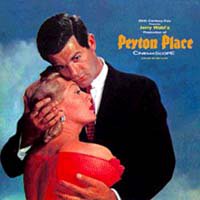
Last night I witnessed one of the most peculiar but pedestrian, unintentionally comic but deadly serious, brilliantly camp yet largely unfunny, tense and plodding, surprisingly epic but cramped, overacted but not quite over-the-top movies I've ever seen. The contradictory (and you're right to assume very frustrating) flick in question was nine-time Oscar nominee Peyton Place from 1957.

I love watching older films and trying to eke out context of the era and the movie culture in which they took place. Though I was always a good student, I can't say I ever took a sustained interest in history and what I commit to memory I largely know from the movies. I'm not proud of that, just putting it out there. So here in Peyton Place a couple of cultural movie things spring right up.

First, you get the late 50s/early 60s movie staples of sex hysteria mixed with dawning awareness of how sexual knowledge (rather than shame) might be a good thing. With that conflict comes cross-generational battles of parents and misunderstood teens. You'll also see this shift in changing mores and a widening general gap captured more brilliantly in two Natalie Wood pictures which bookend Peyton Place; Rebel Without a Cause (1955) and Splendor in the Grass (1961).

The other instant movie connection is to the melodrama form. This tale of gossipy neighbors, lives half-lived, and the ever-present fear of social ostracism recalls both Douglas Sirk's All That Heaven Allows (1955) and its recent tribute/companion Far From Heaven (2002). As melodrama though Peyton Place never achieves those pinnacles. The grand moments are there. The expressive lighting and weeping women show up, too. (And usually just in time as your attention has begun to wander). But, sadly, they only appear in spurts. This New England town's tale is told too episodically and is all too overpopulated to become a classic of the form. (It's easy to understand the film's transfer to television in the 60s as a serialized soap). What's more its failure to fully embrace the theatricality disqualifies it as a camp masterpiece, albeit an unintentional one. Rather than pinpoint an incredibly passionate romance or doomed decision, as most melodramas do, it wants to tell you the stories of at least a dozen major characters.

The plentiful characters and shocking revelations (surprisingly outre for a 1950s picture, both in content and visual cues) give the actors lots of scenery on which to chew. But, despite the five Oscar nominations for its cast (one of only nine films in the history of cinema to have been so richly rewarded) their various performances are a mixed bag of accents and quality. Thankfully they do all feel cohesive in performance style (unfortunately not a given in ensemble pictures). Best by a considerable margin is cool but not collected Lana Turner. The thaw of the ice queen is, for many legendary blonde movie stars (Deneuve, Pfeiffer, etc...), the most familiar of character arcs. But Turner sideswipes the inherent familiarity of this 'letting down her guard' drama by retaining all the prickly edges of her character. She doesn't so much melt as unwillingly crack. The finest moment in the entire film has to be Constance Mackenzie's complete exasperation when her maid breaks down confessing troubling family secrets. The way she spits out "Oh, Nellie. We all have our problems" is hilarious and also perfectly mean. It lazily tries to meet the social demands of empathy while being entirely devoid of the actual feeling itself. Turner is all loathing (for others and self) and evasion in this scene. Constance McKenzie, Turner bravely shows, is a real pill.

With Turner's well-handled matriarchal drama as focus, Peyton Place could have been a great melodrama. But the movie wants to be a town portrait and a portrait of America. And --oh, but wait. There's more. Its last act unfurls a third aim: it's now a courtroom drama! Peyton Place attempts much but accomplishes too little. It belongs not to melodrama but to the soap opera form, i.e. melodrama's inferior cousin, the one with similar DNA but less imagination and no ability to think in the abstract. Still and all, there are strangely vivid moments to treasure and an intermittently fascinating snapshot of America in the late 50s. You just have to sit through lots of filler to find and embrace them. Or such was my viewing experience. We all have our problems, indeed.

B-