
Showing posts with label Tsai Ming-liang. Show all posts

Saturday, November 28, 2009

Golden Horse Awards: Maggie Cheung, Ang Lee, Leon Dai, Tsai Ming-liang

Maggie Cheung alert!
She walked the Taiwanese red carpet today in this white number to your left. She was presenting Best Picture at the Golden Horse Awards. The Golden Horse is Taiwanese in origin but it's for Chinese language films regardless of country of origin so it's very competitive now. Warlords and Lust, Caution, which both had international releases, were recent winners of Best Picture.

This year, Maggie handed the trophy to No Puedo Vivir Sin Ti which, if we ever see it in the States, might be called I Can't Live Without You or Not Without You. That's Taiwan's submission for this year's Foreign Language Film Oscar race. The film is from actor/director Leon Dai and it's about a poor man who loses his daughter once the government learns of their illegal living conditions.

No Puedo Vivir Sin Ti (2009) from Taiwan

Winners
Best Picture: No Puedo Vivir Sin Ti
Best Director: Leon Dai, No Puedo Vivir Sin Ti
This prize was presented by four previous winners: Ang Lee, Ho Hsiao Hsien, Johnny To and Stanley Kwan. Imagine receiving your prize from that illustrious quartet.
Best Actress: Bingbing Li, The Message
You may have seen her last year in The Forbidden Kingdom. The Message is an espionage thriller

Best Actor: Was a tie for the first time in Golden Horse history.
Nick Cheung
in Ching Yan (aka The Beast Stalker) a police drama
Bo Huang in Dou Niu (aka Cow) as a Chinese peasant protecting his livestock in the 1940s
Supporting Actor: Xueqi Wang, Mei Lanfang which is China's Oscar submission this year, a biopic about a famous opera star which also stars Zhang Ziyi
Supporting Actress: Kara Hui, Sham Moh
Original Screenplay: No Puedo Vivir Sin Ti
Adapted Screenplay: Dou Niu
Cinematography: City of Life and Death

Tsai Ming-Liang's gives good eye candy in Visage (Face)

Art Direction: Face
Makeup and Costume Design: Face
Choreography: Ip Man ... choreography is one of those prizes, like stunts, that one has to wonder why the Oscars never thought to reward.
Visual Effects: Fengkuang de Saiche (aka Crazy Racer)
Film Editing: KJ: Music and Life
Sound Effects: KJ: Music and Life
Original Score: The Equation of Love and Death
Original Song: "For My Heart"
Documentary: KJ: Music and Life
Lifetime Achievement: Ming Ji (I'm not sure who this is or why they were rewarded since there are several Ming Jis or Ji Mings listed at IMDB)
Special Contribution: George Wang

Maggie presented Best Picture alone at the ceremony but said publicly that she most wanted to present it with Tony Leung Chiu Wai (her frequent co-star) and Carina (his wife). As Tony -- TFE reader, not the movie star ;) -- reminded me in conversation, this will undoubtedly cause a media stir since Tony & Maggie's
relationship is always primo gossip fodder.

Here's a bit of the fashions on the red carpet. In order of appearance: Terri Kwan (star of Prince of Tears, another Oscar submission this year), Ting Ting Hu
(Ghosted), Lynn Hung, the beauty in yellow plays Ip Man's wife and she's the real life girlfriend of Aaron Kwo, Maggie and Ang, Lunmei Kwai (in black), Shu Qi (who you'll recognize) walks with Ho Hsiao Hsien, Best Actress winner Li Bingbing is with Alec Su (in the leather pants), Yung-yung Chan star of Yang Yang, Vivian Hsu is wearing a necklace that I can't stop staring at.


*
Speak up if you've seen any of these films. A few of you surely have. And can we get a petition going to pull Maggie Cheung out of retirement, please?
*

Thursday, November 12, 2009

Directors of the Decade: Tsai Ming-liang

Robert here, continuing my series of the directors that shaped the past 10 years. It’s difficult approaching a director whose work has gotten little mainstream American exposure, especially when such lack of exposure is understandable. Still, lack of exposure does not negate importance. And some of the most important directors of the past decade are ones that are minimally distributed here in the States. I intend on giving these directors their due, especially when they’ve shaped the decade’s cinematic landscape as much as this weeks subject: Tsai Ming-liang

Number of Films: Five.
Modern Masterpieces: One. What Time is it There (though your humble author admits not seeing his latest film Face, as it may not open here in the Midwest for years. Very sad.)
Total Disasters: None.
Better than you remember: The Wayward Cloud is an interesting film that was unfairly dismissed. If you’ve seen it, it’s probably better than you remember.
Awards: Has won awards at Berlin for The Wayward Cloud, at Venice for Goodbye, Dragon Inn, and has been featured in Cannes and several other international film festivals. Naturally nothing near Oscar’s radar.
Box Office: What Time is it There had the most successful theatrical run, almost hitting $200,000.
Critical Consensus: All of his films are regularly celebrated (with the exception of the mixed reactions for The Wayward Cloud and Face)
Favorite Actor: Lee Kang-sheng has been in every film directed by Tsai, this decade or otherwise.

Let’s talk about:
Missed connections. Southeast Asia is going through a time of significant social and economic change. And just like generations of Asian filmmakers before them, the continent's current crop of cinematic voices are exploring what it’s like to live during such a turbulent time. Some directors are taking a geographical approach, exploring the changing landscape. Others are making films that tell the same story multiple times (both in the past and present). Tsai Ming-liang’s main concern is a human one. He wants to know how we’re surviving in a world where we’re constantly missing out on human connections. In a region with a population over five-hundred-million (this is your Social Studies lesson for the day kids) it's not difficult to imagine how easily one can look into the crowd and wonder: which among these faces could be special to me… and how easy would it be to overlook them?

In this mindset it’s simple to understand how the French-film-loving street vendor from What Time is it There becomes so quickly obsessed with the Paris-bound woman he encounters. Their bond is tenuous and seemingly insignificant but in their world, it may be all there is. Since his obsession manifests itself far too late to catch her, he instead adjusts all the clocks he sees to Paris time. Their connection is minor yet still better than nothing. But don't go thinking all of Tsai’s movies aren’t as narratively obvious as this. If you're looking for visual metaphor you won't be let down. Heck they’re filled with gorgeously photographed visual metaphor. Characters routinely wander down empty narrow hallways in search of life. The surrounding world is always in some state of semi-decay and never-ending water shortages threaten Tsai's characters' unquenchable thirsts. Long languorous takes tell of an existence that meanders by while people wait for something, anything significant to happen (be forewarned, if you don’t like long languorous takes, Tsai ming-liang is not the man for you. But if you do, you’re already a fan and you didn’t know it!).

Tsai ming-Liang

But please don’t take all of this to mean I’ve been sitting here singing the praises of one of the most boring filmmakers of the past ten years. Slow, yes. Boring, never. Things do happen in Tsai Ming-liang movies… sometimes unexpected things. Ghosts haunt buildings; spirits return to possess pet fish, Jean-Pierre Leaud shows up without warning, bisexual love triangles develop around people in comas. Tsai has even been known to throw in an anomalous musical number or two (though in only one film this decade: The Wayward Cloud. For more musical numbers see his 1998 film The Hole (but we mustn’t discuss the 90s!)). And then of course there’s the sex. Because when you’ve given up on finding meaningful connections, there’s always sex. Although by now you’ve probably realized out that movies about immense longing don’t typically feature hot romps in the sack. So if you’re going into Tsai Ming-liang movies for your T&A fix, you may be disappointed (unless you’ve often pondered the unique ways of utilizing watermelon).

Tsai Ming-liang’s films have been garnering critical notice since the early 90’s. And it’s unfair to suggest he’s a new voice or even just now getting his due considering he won Venice's Golden Lion back in 1994 . But his status has been increasing with each new film this decade: What Time is it There? Goodbye, Dragon Inn, The Wayward Cloud, I Don’t Want to Sleep Alone. His most recent, Face, which premiered at Cannes last year, was commissioned by the Louvre and despite mixed reviews will hopefully be coming soon to a theater near you soon. Still if you’ve not yet discovered Tsai Ming-Liang don’t wait, especially if you feel like you live in a world of empty buildings, strange landscapes, unexpected happenings, and just barely missed connections.

Friday, May 22, 2009

More From Cannes: Imelda, Penélope, Brad, Palme D'Or Frontrunners

I'm so far behind on the Cannes coverage! The festival wraps on Sunday. So, without further ado some red carpet beauties and some links to get you caught up if you haven't been online much or were trusting me to bring you the best bits ...so sorry to have kept you waiting.


First up is Imelda Staunton at the photocall for Ang Lee's Taking Woodstock. There was some very very early Oscar buzz for Imelda for her comic portrayal of Dimitri Martin's mom. Rosengje wasn't sold, writing...
I think people are going to be very divided about Imelda Staunton. It was a technically perfect performance and likely imitated the real life counterpart, but the character is written as too much of a caricature. Excluding one great scene involving some.. special brownies she is excessively shrill.
Saïd Taghmaoui, all in white, attended the Vengeance premiere. I feel like I haven't seen him in a movie in forever but I like him. Next up for Saïd is G.I. Joe: The Rise of the Cobra. Kristin Scott Thomas remains a classy red carpet must have. Michelle Yeoh and Kerry Washington, two undervalued actresses that we've always loved here at the Experience, have both been valiantly working the charity circuit at Cannes.

Kerry's getting muscled out of this picture by Brad Pitt & Angelina Jolie, mega-stars (heyyyy, just like she was in Mr. & Mrs. Smith. You're entirely forgiven if you didn't realize Kerry was in that movie. She barely is). Brad was in Cannes for Inglourious Basterds which seems to have a left a lot of people underwhelmed.

All Cannes! All the Time!
Go Fug Yourself salutes Penélope's game face after her food poisoning this week.
Eating the Sun Lots of Philippines upset abotu Roger Ebert's 'worst film ever' comments about Brillant Mendoza's Kinatay
IndieWire on why Cannes still matters
Living in Cinema is jazzed for the new Tsai Ming-Liang film Face. The early stills and the trailer do look like pure eye candy.
NY Post Did you know that Antichrist's end credits cite a "misogyny consultant" Ha! Lars Von Trier continually delights me... and I don't even need to see his movies (not that I don't -- love them, too) for this delight to take place. But then, I've always had a thing for artists who loved to push buttons just to be pushing them and/or to mock themselves or have fun with perceptions of their persona. Madonna used to be in this camp, too.
Twitch rumor has it: Universal is going to ask Tarantino to trim Inglourious Basterds down after the mixed reaction at Cannes. Hey, a little trim probably wouldn't hurt most QT movies.
Getty points to the trend for the red carpet at Cannes and elsewhere: nude (coloring that is)
Obsessed With Film enthusiastically offers 5 reasons to see Sam Raimi's Drag Me to Hell
IndieWire Director's Fortnight winners... a big night for the Quebecois film I Killed My Mother
My New Plaid Pants is waiting impatiently for each new bit on Michael Haneke's The White Ribbon
Risky Business thinks that Haneke's film is going to win the Palme D'Or.

Will these two films be the big winners?

As to who might win... Haneke seems like a good bet but it's not the only film that's been wowing them. Others are saying Jacques Audiard's Un Prophete could take it. (If you don't recognize the name just think of the lively, tense French hits The Beat That My Heart Skipped and Read My Lips... both of which did well in their US runs). But remember Cannes watchers... no one knows anything. The winners are never exactly predictable. This ain't the Oscars. It's a juried competition where they're encouraged to spread the wealth. No one knows who might win what... except maybe Isabelle Huppert.
*

Thursday, April 23, 2009

Cannes Lineup 2009

The following twenty films are competing for that coveted Palme D'Or.

Antichrist Lars Von Trier (Denmark-Sweden-France)
Bright Star
Jane Campion (Australia-UK-France)
Broken Embraces Pedro Almodovar (Spain)
<--- Enter the Void Gaspar Noe (France)
Expect cheer and happy endings!
Face Tsai Ming-Liang (France-Taiwan-Netherlands-Belgium)
  • The first three titles there, bunched up together, feel like some sort of pornographic love letter addressed to me. Not to you, to me. Mine. ALL MINE. Three of my favorite filmmakers with new completed films, one right after the other? Talk dirty to me on the Croisette, Cannes programmers. Talk dirty to me.
Fish Tank Andrea Arnold (U.K.-Netherlands)
Les Herbes Folles Alain Resnais (France-Italy)
In the Beginning Xavier Giannoli (France)
Inglourious Basterds Quentin Tarantino (US)
Kinatay Brillante Mendoza (Philippines)
  • Brillante (right) sure is prolific. His last film Serbis was a difficult sit. I continually felt like I was missing something having little knowledge of Pinoy film or culture. But, that said, it wasn't a fast fade either. I still find myself thinking about it: the goat in the movie theater, the aggravating weary repeat walks up and down those enormous staircases, the family unable to deal. Resnais is 86 years old and still making movies but his presence is another reminder that Cannes is pretty conservative with their choices. Reading through the list of films reminds us that Cannes is more likely to stick with laureled auteurs in the main field. The new talent generally has to battle it out in other sidebars.
Looking for Eric Ken Loach (U.K.-France-Belgium-Italy)
<--- Map of the Sounds of Tokyo Isabel Coixet (Spain)
a dual identity drama starring Rinko Kikuchi
A Prophet Jacques Audiard (France)
Spring Fever Lou Ye (China-France)
Taking Woodstock Ang Lee (US)
  • Why am I not more excited for new films from both Ang Lee and Quentin Tarantino? My best guess is that the comedic nature of Woodstock is throwing off my general Angthusiasm and the extreme violence of Basterds -- not to mention its trouble with spelling -- is putting a damper on the latter. I'll see both of course.
Thirst Park Chan-wook (South Korea-US)
The Time That Remains Elia Suleiman (Israel-France-Belgium-Italy)
Vengeance Johnnie To (Hong Kong-France-US)
Vincere Marco Bellocchio (Italy-France) --->
Starring Giovanna Mezzogiorno as Mussolini's secret lover Ida Dalser
The White Ribbon Michael Haneke (Germany-Austria-France)
  • More Cannes regulars.
Some potentially exciting titles outside of the main competition include: The Imaginarium of Doctor Parnassus (Terry Gilliam), Agora (Alejandro Amenabar), Tales from the Golden Age which is an omnibus film from Romania (Cristian Mungiu of 4 Months... fame has two segments), Drag Me To Hell (Sam Raimi) and Push/Precious/Untitled/Based on Book by Sapphire.

The congested world famous festival runs May 13th-24th in France.
*

Sunday, September 16, 2007

An American in Toronto: Days 5-9 (Doldrums and Exhaustion)

Steve reporting from the Toronto International Film Festival

The hectic Toronto pace caught up with me. That's my excuse, and I'm sticking to it, mainly because it's the truth. The grind of hustling from theater to theater and sticking out one film after another while forgoing sleep wore me down in more ways than one -- on the 13th, I ended up seeing exactly two films. But there's more than that -- once I got past Day 5, the highs and lows, the films about which to get passionate, kind of dissipated and I was stuck watching one mediocrity after another. Still, I promised coverage, so coverage will be given. Even if it's half-assed, bleary-eyed coverage.

So here it is: a big, unpolished List o' Film that covers everything I saw from September 10th to 14th. The list goes in ascending order, so skip to the bottom if you're merely curious about what might have been good.

Exodus (Pang Ho-cheung): An okay short film turned torturous by the extension to feature length. Simon Yam plays a downtrodden cop who is told by a man arrested for voyeurism in a public women's bathroom about a female plot to exterminate all men; unfortunately, that plot, which in another film would make for a cracking B-movie, gets expressed via endless sequences of Yam skulking around, stalking the man, starting a relationship with the man's ex-wife, ignoring his own wife, etc. Yam's forceful charisma gets quashed by the thorough dullness of the character, and Pang's workmanlike direction does him no favors either. The very definition of a GUNDAN Movie.

Sad Vacation (Shinji Aoyama): Aoyama's films, of the ones I've seen, generally deal with people finding ways to deal with tragedy and horror in their lives; he's just never expressed said theme in such a lame way before. Story wanders, gets stuck in dead ends (what the hell is with the flameout on the subplot with the kid?), generally goes nowhere as slowly as possible. Aoyama's direction is surprisingly bland, lacking even the slightest hint of the dynamic visual sense that distinguished Eureka and Eli, Eli, Lema Sabachtani?. Even Tadanobu Asano, who is usually way more awesome than he is here, can't save this meandering dross.

Redacted (Brian De Palma): I wonder if De Palma realizes that he already made this film with Casualties of War and that it was a lot better without the multimedia verite clumsiness. Also, I wonder if De Palma knows that he keeps muddling his own message (i.e. the awful YouTube thing at the end, which I think is supposed to represent the gradual radicalism of youth culture but merely makes anti-war proponents look like ignorant, ill-educated, reactionary jackasses). I admire the intent, but I'm not sure reducing a complex and troubling issue to a black-and-white morality play inhabited by tortured noble folks and evil straw men is quite the way one should register one's disgust.

Help Me Eros (Lee Kang-sheng): Alternate title: Lee Kang-sheng Likes Pot and Sex But Especially Pot. Lee demonstrates that he's learned a thing or two about quiet pacing and image-making from his frequent director Tsai Ming-liang (the light show that plays off the bodies of the participants in a menage a trois is pretty cool); however, the lethargy and aimlessness that infects his main character is allowed to creep into the fabric of the film itself. Narcotized is the right word, I think.

Dr. Plonk (Rolf de Heer): The recreation of silent-film comedy technique is pretty impressive. All the technique in the world, though, can't make this funny. A bit too leisurely for my tastes, really -- I prefer the more frantic stylings of Buster Keaton.

Glory to the Filmmaker! (Takeshi Kitano): What the holy hell IS this thing? Completely insane knockabout comedy has several laugh-out-loud moments (my favorite being Kitano reacting to an evil spirit) but becomes wearying when its shapelessness becomes apparent. Some structure -- even a little bit -- would have helped this feel like more than a hazy collection of gags and non sequitors. There's no question that Kitano, at this point, is doing exactly what he wants, and that's cool, but he's doing it at the expense of the audience.

Dai Nipponjin (Hitoshi Matsumoto): Melancholic comedy in a mock-doc style, about a hangdog middle-aged screw-up who occasionally transforms into a skyscraper-tall superhero and battles "baddies," has some funny moments courtesy of Matsumoto's pitch-perfect performance in the title role. The big CGI sequences detailing the epic battles, though, generally kill the film's momentum, and there's no earthly reason that a lark like this should stretch to two hours. The best sequence is at the end, when the style of the film shifts to great effect; unfortunately, like everything else in the film, it's allowed to go on too long.

The Girl in the Park (David Auburn): Lots of good acting from Sigourney Weaver, Alessandro Nivola, Elias Koteas and even Kate Bosworth (an actress I generally despise) in this drama about a woman, damaged by her daughter's fifteen-years-prior disappearance, who forges a strange connection with a young layabout. However, though there's a lot I like about playwright David Auburn's directorial debut, I never bought the central relationship between Weaver and Bosworth for a second, and as such the film never quite convinces. Best scene: Bosworth regaling a fifteen-year-old boy at a party with a long, sordid invented life history. Worst scene: The long dinner sequence immediately following that scene.

Honeydripper (John Sayles): Exactly like Casa de Los Babys, the last Sayles film I saw -- nicely acted, sensitively written, intelligent and completely inert. I doubt I'll remember this film in two months' time. Whatever happened to the guy who gave us Lone Star and Limbo?

Mad Detective (Johnnie To & Wai Ka Fai): Like most of Johnnie To's films, this has a fabulous opening sequence. And like most of To's films, this never tops its opening sequence. Interesting for a while, but eventually buckles under the weight of its overloaded premise (a detective solves crimes by seeing people's "inner personalities"). Some streamlining might have helped, but nothing could have helped the jejune broken-mirror symbolism, which hasn't been fresh since Dario Argento flogged the hell out of it in the '70s.

The Last Mistress (Catherine Breillat): Breillat's first film since a near-fatal affliction that put her out of commission for several years sees her rendering her traditionally fiery gender politics in a more muted tone. Has many sharply observant moments and a properly fierce lead performance from Asia Argento; the second hour, though, is a bit redundant. Also, it's not Breillat's fault, but her film suffers in proximity to Rivette's The Duchess of Langelais, which has practically the same plot. Still pretty good, at any rate, with a perfect final cut.

Nightwatching (Peter Greenaway): Looks like Greenaway is ready to come back to Earth after The Tulse Luper Suitcases -- this biopic centered around the circumstances that led to Rembrandt's creation "The Night Watch" is, by Greenaway's standards, an accessible and traditional work of historical drama. By anyone else's standards, though, it's still pretty nutty, with an overtly theatrical approach to the staging, a thick atmosphere of hysteria and conspiracy and a preponderance of breasts and penises. Loses a little thrust when it abandons Greenaway's unsparing, earthy sense of humor and gets serious in the second hour, but worth consideration anyway as the promising return of a wayward master. Martin Freeman's exuberant, lusty performance as Rembrandt would be a starmaker in any other world.
Eat, for This Is My Body (Michelangelo Quay): Heavily symbolic rumination on the effects of Haitian colonization is beautifully filmed but a bit obscure and contains some shocking mixed messages. (Surely the scene with the children and the cake can't be saying what I think it's saying?) Fortunately, it sorts itself out about halfway through; it takes some time to understand what it's getting at, but it's worth the wait. This one's stuck in my memory, and I kind of hope I get a chance to see it again. Sylvie Testud makes a striking impression despite saying maybe twenty words total. Caveat emptor: There were more walkouts at this screening than at any other I attended.

A Girl Cut in Two (Claude Chabrol): Shockingly, this is my first exposure to Chabrol, and this makes me want to explore further -- it's a seductive and sneakily decadent tale of a woman caught between two rich men. Proceeds like a light comedy of manners until a certain fade-out halfway through, at which point it slips through the back door of suspense. The last ten minutes leave a bad taste, even viewed through the prism of upper-class exploitation of willing lower-class citizens, but I'd be lying if I said I wasn't entertained.

Paranoid Park (Gus Van Sant): Gorgeous meditation on states of physical being by Van Sant, who directs this thing for all it's worth. Bears superficial similarities to Elephant, but unlike that film Van Sant uses his non-chronological structure and sound design to implicitly takes a moral stance against the kind of teenaged apathy that leads to what happens here. Lead performance a bit deficient, but the rest of the cast performs admirably in a Bressonian-model sort of way.

Encounters at the End of the World (Werner Herzog): Herzog, one of my favorite filmmakers, keeps his late-career resurgence humming along with this smashing documentary at a research station in Antarctica that, among other things, functions as a somewhat grumpier yet still intoxicating companion piece to his strange and mournful The Wild Blue Yonder. The bizarre and beautiful visuals that Herzog seems to attract are plentiful (like the shots from inside a lava crater); unexpectedly, this is also funnier than most things that pass for comedy in modern cinema. The scene where Herzog hassles the penguin expert with hilariously inappropriate questions is, in itself, worth the film's length. That it also serves as a lead-in to a funny yet poignant image seems appropriate.

You, the Living (Roy Andersson): The knock on this is that it's very, very similar to Andersson's earlier chunk of mordantly deadpan wit Songs from the Second Floor. To which I can only reply: Yes, and? Two similarly awesome films are better than one, right?
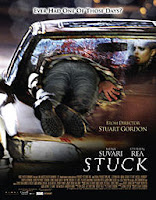
Stuck (Stuart Gordon): I generally like Gordon, but if someone had told me that Gordon's new film, arriving with no expectations, would better the new films by Romero, Kitano or Argento, I probably wouldn't have believed you. (Well, maybe that last one.) What Gordon has done here is take the bizarre true-life case of Chante Mallard, the nurse who drove home with a homeless man she had hit stuck in her windshield and left him to die in her garage, and spin it out into a gruesome, blackly funny horror film in which the monster is towering self-involvement. Gets as much mileage as can be gotten out of its premise, with complications and screwy plot developments keeping interest fresh and tension high, and Gordon never lets the pace flag once Stephen Rea flies through the glass. Rea exudes desperate determination as the man in the window, while Mena Suvari perfectly portrays the type of blinkered obliviousness and concern for one's one station above all others that would be necessary for this sort of thing to seem okay. Builds more momentum and gets more amazing the further down it follows its diseased muse until the brutal showdown finale, where it transcends onto some generally-unexplored plain of tough-minded B-movie nirvana. If I haven't made it clear enough yet: This movie is freakin' awesome.

Miscellany and wrap-up tomorrow...

Wednesday, September 05, 2007

Notes (and a Plea) from Venice - Day 7/8

Boyd from European Films here, reporting on the ongoing Venice Film Festival

Mood:
tired
Weather: sunny but not particularly warm
Films seen: Cassandra's Dream, The Nines, La graine et le mulet, Un baiser - s'il vous plaît, The Darjeeling Limited, Hotel Chevalier, Il dolce e l'amaro, En la ciudad de Sylvia, Der Freischwimmer, Mal nascida, Sukiyaki Western Django, Désengagement
People currently on the same square mile of earth as I am:
Peter Greenaway, Manoel de Oliveira, Amos Gitai, Tsai Ming-Liang, Charlotte Gainsbourg, Tim Burton, Johnny Depp.

A Plea from Venice:

Dear directors (and dear editors of the aforementioned),

Life is short. Please remember this when putting your films together. Life is short. Repeat after me: Life is short. Life is short. Life is short.

Directors! What has happened to you? If the new films presented at the 2007 Venice Film Festival are any indication, anything shorter than 80 minutes is considered a short film, and anything shorter than 100 a medium-length feature. Don't you think viewers and especially critics don't have anything better to do?

Here is the e
vidence for my case:

Atonement:
123 minutes
Se jie (Lust, Caution): 156 minutes
Sad vacation: 136 minutes
Michael Clayton: 119 minutes
In the Valley of Elah: 120 minutes
Les amours d'Astrée et de Céladon -
109 minutes
Empire II - 180 minutes
Hotel Meina - 110 minutes
Cléopatra - 116 minutes
Cassandra's Dream - 108 minutes
La fille coupée en deux - 115 minutes The Assassination of Jesse James by the Coward Robert Ford - 155 minutes
La Graine et le mulet - 151 minutes
I'm Not There - 135 minutes
Sukiyaki Western Django - 121 minutes
Désengagement - 115 minutes
Freischwimmer - 110 minutes

Nightwatching - 134 minutes
and the list goes on...

Do you really think we have nothing else to do in life? That we have no friends, no family, no TV set, no internet connection? What is wrong with you people? If you want to mirror life in your films, please remember what I said earlier: life is short.

In the list above, there are only two films that merit every single minute of their running time: Atonement and The Assassination of Jesse James by the Coward Robert Ford. Both are historical epics and benefit from the long running time (in Atonement's case it should ideally have been e
ven a bit longer; it's closing section is handled too quickly). All the other filmmakers have committed what might be a minor infraction if you are out on your semi-weekly multiplex visit, but what turns out to be something on the level of a crime against humanity if you are at a film festival.

If all the films above would have been shortened by just ten minutes, I would have had three whole hours of my life back, in which I could have: a) seen two medium-length films, b) watched the restored copy of D.W. Griffith's Intolerance playing here in Venice, c) gone out for a nice Italian meal d) gone for a swim in the Mediterranean and a nice Italian snack.

So, my dear directors, pleas bear this in mind when putting together your next film. Less is more. Life is short. Critics also like solid food instead of straw-fed Red Bull and coffee. And a dip in the Med is more than they could ever hope for. After any of the above occurrences (or -- God forbid --
a combination of them) , they might even be more mildly inclined towards your movies as they will not review them in a state of lethargy or somnambulance.

Thank you for your future consideration.

(a sleep-depraved) Boyd
editor of european-films.net and
TFE guest blogger from Venice

NB: Note to the editors working with the directors: If you feel that the film you are working on is too long, please advise the director to "jump straight into the story" (read: chop of the endless city-, landscape or other useless shots at the beginning) and t
o go for an "enigmatic" ending (read: chop ten to twenty minutes of the ending).

Reviews:

Though I've seen a lot more, I haven't been able to review much (or very extensively) for the past two days, since I've had about a dozen interviews that will be published in the upcoming weeks at european-films.net.

What I can give you are the two reviews of highly anticipated titles that both come with reservations: Wes Anderson's The Darjeeling Limited and, as promised, Woody Allen's Cassandra's Dream. Both star stars and are too long but should appeal to fans of the directors. The links above are to the medium-length reviews on european-films.net.

The score board:

On the score board published in the festival daily, the French film La graine et le mulet (The Secret of the Grain) is currently the top choice of both the Italian critics and the Italian audience so far, with Branagh's Sleuth in second place for the audience and the critics placing their bets on Rohmer's Les amours d'Astrée et de Céladon. My personal top three of festival films so far:
The Assassination of Jesse James by the Coward Robert Ford, Atonement and Se
jie (Lust, Caution)
.

Tim Burton & Sweeney Todd:

Earlier toda
y, US director Tim Burton received the Career Golden Lion from the hands of an actor completely unknown to the director until the time of the ceremony: Captain Jack (the two bearded and bespectacled men can be see in the picture above, courtesy of Fabrizio Maltese). In honor of the director, the festival declared September 5 "Tim Burton Day" and screened the 3D version of The Nightmare Before Christmas and the first eight minutes of Sweeney Todd, which I haven't seen but which I have been told were quite out of the ordinary (not that anything less would have been acceptable from Burton).

The director walked down the red carpet with his rotund partner Helena Bonham Carter (she is eating lots a the moment but has good reason: she's pregnant), who plays the pie-baking Mrs Lovett in the adaptation of the Sondheim musical about the demon barber. Johnny Depp plays the sharp-cutting title character.