Showing posts with label Oscars (40s). Show all posts

Saturday, October 09, 2010

BPFTOI: Driving Through the Best Years of Miss Daisy's Lives

"Best Pictures From the Outside In" is back. But, oh fiddle, because the series is so infrequent we have to keep explaining it. It's a joint production between Mike at Goatdog's Blog, Nick at Nick's Flick Picks and Nathaniel at The Film Experience. We began in 2008 pairing the most recent winner No Country For Old Men with the first winner Wings and we've been working our way inward ever since from both ends of the Oscar chronology. Get it? Got it? Good. We've now reached 1946 vs. 1989.

 These men have been through enough Daisy. Let Hoke take the wheel!

NATHANIEL: Just when you get used to things a certain way...

Nothing is more certain in life than change so it's something of a human mystery as to why we're always so surprised or discomforted by it. In the Oscar winners The Best Years of Our Lives (1946) and Driving Miss Daisy (1989), we have four protagonists who are dealing with it from the comforts and, this is a fine point, new discomforts of their own homes. When I say "dealing with it" I sometimes mean not dealing with it all. It's a testament to this double feature that there's quite a lot of truth in the coping mechanisms presented, up to and including the coping mechanism of not coping. Sometimes we all just need a little time.

(Oscar sometimes needs a lot of time, which is why he likes to reward social issues movies like Daisy that take place in the rearview mirror.)

Since I mentioned four protagonists, allow me to introduce them. I'm referring to the three World War II veterans Al (Fredric March), Fred (Dana Andrews) and Homer (Harold Russell) who are returning to the homefront in The Best Years of Our Lives and the widowed Jewess (Jessica Tandy) of Driving Miss Daisy who is holed up in her estate when she's suddenly deemed unfit to drive. I stop at four because, Morgan Freeman's Lead Actor nomination aside, I can't buy Miss Daisy's chauffeur as anything like a fifth protagonist. Though he's quite literally driving, he's incongruously but a passenger.

Miss Daisy wants Hoke to drive at the speed of walking but I want the both of you to answer the following question like you've got a lead foot and somewhere else to be. (Let's just get it out of the way and drive on). How offensive (or not) did you find Hoke and/or the movie's complete lack of interest in his story and how much of that was mitigated by the entertainments of Grumpy Old Woman?

MIKE: It's not just uninterested in Hoke's story, it's uninterested in the entire story of the black freedom movement in the three decades after World War II. The only mention we get of anything approaching the Civil Rights Movement is a 1966 speech by Martin Luther King, more than an hour into the film. The only racist violence we hear about is the bombing of a Jewish synagogue. The only racist encounter we see occurs on a trip to Alabama --so I guess Atlanta in the 1960s was a little model of cooperation, as long as the help stayed in the kitchen and didn't grumble under their breaths too much. But there was a TV in that kitchen--surely SOMEONE saw SOMETHING going on that poked a teensy hole in the "slow and steady evens the races" model this film is pushing. And that ending--"You're my best friend, Hoke"--is one of the few times you'll ever see me moved to praise the recent Best Picture winner Crash, because I sort of think Crash knew how ridiculous it was when Sandra Bullock says the same thing to her beleaguered housekeeper. But here in Miss Daisyland, there's no such thing as self-examination. Meanwhile, out in the world, while the Academy was praising carefully crafted, Old Left films about gradual social change, Spike Lee was tossing garbage cans through windows trying to get people's attention. The Academy noticed, of course--the white dude in Do the Right Thing got a Supporting Actor nomination. This film, and this window into the Academy's soul, both make me sick.

 Hollywood Race Relations: Sincere or Ridiculous?

NICK: That's a tough act to follow, so my only option is to surprise even myself by at least playing devil's advocate for Driving Miss Daisy. Just to be clear, I don't think it's a good movie, and along with Field of Dreams and Dead Poets Society, it serves as proof that AMPAS somehow Rip Van Winkle'd its way through one of the stronger years for commercial film in the 1980s. (Then again, the directors and the actors and the writers and the nominators in almost every single category had better ideas than the high-fructose consensus that emerged in Best Picture, so maybe 1989 just proves the liabilities of how the Best Picture slate is determined.) Daisy's images are almost unrelievedly similar and boring. The editor often falls asleep. The score gets hilariously bombastic and misused after that pleasingly shuffle-along title melody. The biggest problem for me is that the script and the direction seem so damned tentative about pressing further into almost any of the story ideas or thematic issues it raises.

But I have to say, on that score, the script doesn't seem inclined to poke around Miss Daisy's backstory or the dilemmas of being Jewish in mid-century Atlanta any more than it wants to poke around Hoke's past or his private life. I don't think she's any more of a "protagonist" than he is, really. When the movie clicks at all - and it does for me, just a little bit, in its closing scenes - it's because I actually do think it hints at the thinness of the bond between these characters, who never know each other very fully even as they gradually feel warmer to each other or get more involved in each other's lives. Daisy's "You're my best friend" is, after all, uttered amid a bout of dementia, and Freeman doesn't imply that Hoke agrees here at all. The golden close-up on their clasped hands is a bit much. But almost immediately Daisy cuts to a very dark long-shot unlike almost anything else in the movie, which makes Daisy herself and this plaintive exchange both look awfully feeble and cold.

NATHANIEL: Well, when your only other option for Best Friendship is your obtuse son with the wandering suthehn accent and your silent housekeeper, isn't chatty Hoke a good option? At least he'll laugh at your jokes.

NICK:  That generous sense of humor helps this movie a lot. It's one of the hundred or so ways in which Freeman manages to bat back at the cloying and insulting potentials in this script and make Hoke (for me) an intriguing, legitimate character. In terms of what Mike pointed out, I do also appreciate that quick, earlier moment when he rebuked Daisy's idea that race relations were "totally changing" in the era of King.

MIKE:  I totally agree that there should be more to this discussion than just DMD's racial politics, but I keep getting dragged back--Hoke's sense of humor reminds me of the skit in the middle of Public Enemy's "Burn Hollywood Burn" about the casting director looking for a black actor willing to play a "controversial" character (a butler who chuckles under his breath). But you were saying.

NICK: I do agree it's demented to vote this Best Picture, and a particular slap in the face in the year of Do the Right Thing (or Crimes and Misdemeanors, or When Harry Met Sally..., or Roger & Me). But I think the movie finally shows at least some sobriety and tact about exactly what kind of relationship these two have. I don't think Daisy does a very good job even at being the basically safe movie it is, but I don't know that it's fair to ask it to be Do the Right Thing, either. I'm much more annoyed by movies of this era like Mississippi Burning, which styles itself as exactly the kind of bold, historically minded, race-focused protest picture you want Daisy to be and actually distorts the record and omits black perspectives even more than Daisy does.

 "Well, I'll be. We got 9 nominations and 4 Oscars! Do The Right Thing went 0 for 2"
That Hoke... such a kidder. Wait, that was a joke, right? That didn't actu ---oh god.

NATHANIEL: I'd actually love to excuse the Academy's love of this whole mini genre of minority struggle narratives coopted to tell stories of tolerant white people (see also the previous Best Picture's episode!) as dementia. At least then, they'd have an excuse. But it's a wider problem than just Oscar taste level. Critics, media and audiences tend to embrace these films in large numbers, too.

MIKE:  OK, off the topic of racial politics, there are some things I like about this film. That snappy little jingle that pops up in the score when it's not being bombastic is tops for me. I think I like Hoke, mostly because of the gravitas Freeman brings to the character, which keeps him from drowning in the script. The glowing cinematography got old, but there's some darkness that verges on the wildly experimental, given the film's overall conservativeness: that weird "oh my god look at all our reflections in the mirror" bit during Tandy's first "spell" seems like it's dropped in from a different film, but the long, dark shot at the end that Nick mentioned is a sobering way to close things. And I sort of like Dan Aykroyd, despite the wandering accent, for his genial longsufferingness. As for Jessica Tandy, I couldn't really separate her performance from the film: it seemed like one of those "oh no this old lady's gonna die soon" awards that happened a few times (some deserved, some not) in the 1980s.

NATHANIEL: You know how difficult it is for me to praise Jessica Tandy here (given the Oscar tragedy that played out... that unspeakable tragedy that I'm always speaking about) but I do think she does fairly good work with the innocuous material. Not Oscar nomination worthy good but good all the same. I like that you can see cracks growing in her "I'm not prejudice" mantra. She's not exactly self aware but she's not exactly not either and you can see that this annoys her more than it moves her towards actual change or self examination. That feels, to me, like a cool acknowledgement of the way people often process their own failings.

And this movie can take any tiny cold snap anyone can gift it with. The cinematography was so golden soft that I felt it was constantly trying to tuck me in for bed with a very warm blanket or roll me right up into a papoose so that I'd never have to feel anything uncomfortable or chilly ever again.

But I like the chill since it helps me appreciate the warmth.

War heroes in the round: The Airman, The Soldier and The Sailor return home.

Speaking of which, how about the versatile cinematography and shot composition in The Best Years of Our Lives? I swear to god... it was like entire miniature movies in every scene. Warmth and chill and other glorious complements everywhere I looked.

NICK:  Totally! The approach to lensing, shot structure, and editing in The Best Years of Our Lives is just so inspiring. I remember being not prepared at all when I first saw the movie, because I wasn't used to looking for technical virtuosity or intense formal variety in projects that look on the surface like unpretentious domestic soapers. This is the kind of movie that Hollywood so often shoots so boringly--relying entirely on actors to drive home all the emotional beats in the script, as though trying to convey feeling through focus, camera movement, lighting contrasts, or whatever would somehow undercut those emotions. Which is funny, because just within this series, William Wyler's own Mrs. Miniver seems like a good example (as, frankly, does Driving Miss Daisy) of exactly that sort of punch-pulling movie. Still within this series, though it's nothing like The Best Years of Our Lives, American Beauty was another example that if you explore middle-class domesticity with formal flair and visual invention, the ticket-buying populace really can get excited about it.

 William Wyler in the 1940s. Did any director ever have a decade this good?
6 Features | 2 Best Pic & Dir. Winners | 3 Best Pic & Dir. Nominees |
1940s Haul for Wyler Features: 47 nominations | 18 wins
| 1 Honorary

I don't absolutely adore Best Years the way I did on first pass, but if you compare it to the chilly, self-conscious formalism of Wyler's Little Foxes in '41 or the unambitious warmth of Mrs. Miniver in '42, it's just amazing that he's able to rifle through his entire bag of technical gambits and still make the Derrys and the Stephensons and the Camerons and the Parrishes at least as dear to us as the Minivers were. More so, really.

MIKE:  I'm with you guys 100%, except the part where Nick doesn't absolutely adore Best Years like he did on first pass, because I think I love it even more this time around. It vaults into my handful of best Best Picture winners ever (which might seem like damning with faint praise). What jumped out to me most this time around was Gregg Toland's use of deep focus, which he had knocked out of the park a few years earlier in Citizen Kane. He uses it with such versatility here, and it's amazing how many different things it can do depending on the context of the scene. My two favorites were (1) the barroom scene where Harold Russell and Hoagy Carmichael were playing the piano in the foreground, Fredric March was nervously in the middle ground, turning from the piano to the far, far distant background where Dana Andrews is giving Teresa Wright the heave-ho via telephone. It's like there's a million miles between them! And (2) the wedding scene (which still makes me cry) with Andrews's face in the foreground, the happy couple in the middle, and an angelic-looking Wright in the background. Here, the focus pulls everyone together, emphasizing their closeness.

One filmmaking technique = Two entirely different feelings.

And I love your "unpretentious domestic soaper" line, Nick, because the film does feel episodic. You could "tune in" for a couple of scenes and then go do your laundry, then come back and watch a different section of the movie. Not many films feel like they can work as a whole or as bite-sized, but still self-contained, chunks. And even though it's following more than a half-dozen characters, it manages to make them more fully formed than Daisy did with three. (And the extended running time only partly explains that.) Who's your favorite? Mine is Dana Andrews's Fred, who uses Andrews's unique bruised masculinity better than any of his other performances.

NATHANIEL: Hear hear on Dana Andrews. His performance felt like a marvel of internal distress signals to me... which made his inappropriate romance with Teresa Wright so relatable; she was tuned to his frequency. Her erotic attachment to him is not as simple as "I can save him" but that element is definitely there. Fortunately, despite all the potential cliches this team is working with I feel like they just nail down the core truths of certain familiar tropes with such precision and force. One scene that really knocked me over with its expressiveness in both performance and direction -- all the filmmaking tools Nick mentioned -- was Dana's solo moment in the cockpit where he lets himself access the war memories he's been keeping at bay. I found it to be such a beautifully judged emotional climax but used as transition into the last sequences where the storylines thread back together for the wedding.

 This cockpit has seen heavy fire; this pilot is all burned out.

You know, I think today's audiences (and I'd include myself here) are missing out whenever they dismiss earlier entertainments as "simpler times". Just because the movies didn't have body counts, profanity or sex scenes, doesn't mean they weren't extremely adult in tone. In fact, it's tough for me to even imagine a modern war drama delving this deep into both interpersonal connections and abcesses. You mentioned the movie's episodic nature and maybe that's why it plays out with such modernity to me. I felt like I was watching a lost Emmy-winning series from HBO or AMC had either been around in 1946. There are just so many through lines and longform dramatic beats in the screenplay.

My least favorite of the film's three threads is Harold Russell's. It wasn't because his scenes weren't moving so much as they didn't transcend their romantic drama / war film templates as well as the other two stories did. Aside from Dana Andrews, my favorite star turn belonged to Myrna Loy. She works absolute magic in her wifely duties both to Fredric March and to the picture itself, keeping so many scenes grounded with pragmatism, patience and a lived-in resiliency. Loy gives you a real sense of both what her character was like as a wife before the war and how the war changed her even from the peaceful homefront. But despite her realistically portrayed wariness and annoyance at some of the life changes on the way, she's such a comforting grounded presence that you know her husband (and the larger movie) will be able to work through his post-traumatic stress issues and readjust as best he possibly can to civilian life.

NICK:  Agreed on Andrews: so great at charting implosive feelings, right before that became the sole province of neurotic Method tics. Agreed on Loy, whose taking-in-stride of her husband's embarrassing bender is played so simply, but is so modulated and complex. I like Wright slightly less than these two, but I like her for all the reasons Nathaniel cites. That none of these three got Oscar noms despite the juggernaut status of the film is too bad. I'm sure Andrews is too "quiet" for AMPAS tastes, and I wonder if the studio deferred to March's star power by putting all their push behind him. There could well have been category confusion about the women, but honestly. They nominated Jennifer Jones for playing a tempestuous Tex-Mex and Flora Robson for glowering in blackface. Blackface!

Fredric March is one of my favorite actors, and I have plenty of glowing things to say about him, too. I'll leave myself to one, since it overlaps with Wyler's staging idea: the famous moment when he returns home and each family member discovers his presence, one by one. Everyone's great in this scene, which uses depth of field so conspicuously you can feel the "staginess" despite the marvelous emotion that still pours out of this reunion. And I think March brilliantly accounts for some of the "staged" quality of the filmmaking into his psychological profile of the character. Al clearly likes the idea of a Heartwarming Reunion, and it's not as though he's at all insincere. But as poignant as the moment is, you see how quickly he realizes he's not ready for all this, and kind of wants to be left alone. Tearful embraces are great, but they don't tell the whole truth.

 We've got choreography! A beautifully "staged" family reunion.

I don't think all of Wyler's ideas work so perfectly or integrate themselves so well. If there's anything to be said against the movie for me, it's that you almost hear Wyler and his team figuring out what nifty lensing or staging conceit they want to try out now. It's like the directing version of Kael's notorious anti-Streep comment: click, click, click... And, way too many times, the "big idea" they bring to Harold Russell's scenes is, "Let's make the audience patiently watch while he does something in real time that you'd imagine a man with no hands could not do."

Still, the film is so obviously humane and, in ways that count, emotionally restrained enough that it never feels exploitative of Russell, or of anyone else. And I totally agree that the whole movie is a remarkably rangy, sobering, and novelistic experience. I second (or third?) every lovely thing you guys have said about it.

NATHANIEL: Novelistic is right which is why this movie could easily provoke a week's worth of conversation... but we have to draw the line somewhere.

Am I correct in assuming we all think the Homer (Harold Russell) third is the film's least effective? As someone who generally distrusts sentiment in movies (I often feel like it amounts to emotional pornography, all mechanics with manufactured emotions) I was surprised how well these scenes did work for me. And I think it's for the reasons you've stated. Yes, it's a little obvious but I admire that Wyler is willing to put us in an uncomfortable place as an audience on his way to more traditional movie warmth. More than once the audience awkwardly shares the wary emotional POV of Homer's fiance's parents. We're forced to gawk and even though our hearts are telling us this is an incompassionate place to be, you do have to wonder if you'd want that caretaker life for your daughter.

Just discussing this movie makes me want to dive back in right now. It totally earns its sentiment and that's a rare achievement.

MIKE:  Looking back over fifty years, Harold Russell’s story is the least effective, for the reasons Nick mentioned—the goal here was to have a heart-to-heart with American audiences who were going to have to get used to seeing that kind of thing, and to remind them of the sacrifices people made in the war. It’s certainly part of the overall message of the film, that war is not necessarily glorious, it messes people up both physically and emotionally, and it might make your husband/boyfriend/son seem like a stranger. But we don’t need that patient semi-lecture today; we’ve seen Platoon and Saving Private Ryan and countless other films that take that as a given. So Russell’s story is where the film seems too message-y (although I absolutely LOVE how Toland shoots his house), and it lacks the acting firepower of the other storylines, and it is too occupied with that “this is how you take off your pants if you don’t have hands” pseudo-documentary feel. But Russell’s story gave us those wonderful scenes in Hoagy Carmichael’s bar, which rank among my favorites in the movie. So there you go.

 You hardly recognize them. They hardly recognize themselves.

The absence of that “we have some tough things to tell you” attitude was what irked me the most about Driving Miss Daisy, which wanted it both ways—it’s a loving paean to a way of life that’s long since disappeared, but it’s also a (spineless) criticism of that way of life. Best Years shows us that you can demonstrate your love for small-town America while still taking it firmly to task for being bigoted, or unthinking, or unappreciative. To do it mostly without preaching is a little miracle.

Of course, next time around we’ll have preaching up to our armpits, as Elia Kazan and company grab us by the scruffs of our neck and teach us a lesson about anti-Semitism in Gentleman’s Agreement; it will
be paired with one of the weirdest Best Picture choices of all time, Rain Man, and I can only imagine how we’ll pine for the warmth and complexity of Best Years of Our Lives as we give each other those baffled but affectionate looks that Morgan Freeman kept giving Jessica Tandy. Oscars. There’s lots of them.
 Miss Daisy stubbornly insists on walking to the video store to rent Rain
Man
and Gentleman's Agreement. She doesn't know from Netflix.


NATHANIEL: Readers, back to you. Chime in!

for a complete index of this series thus far, click here.
*

Wednesday, August 18, 2010

Hit Me With Your Best Shot: Black Narcissus

In this series, we choose our favorite single image from a pre-determined movie. It can be because it's the most beautiful, resonant, telling or unusual. It can be deemed the "best shot" for any reason really, beauty being in the eye of the beholder.

Today... nuns in the Himalayas in Black Narcissus (1947). I had never seen Black Narcissus before this week and that sort of virginity is sacrilege. Lose it if you haven't. Watch this film.

The movie tells the story of a new convent in the Himalayas. Sister Clodagh is the superior. She's played by Deborah Kerr, who is absolutely deserving here of one of her other Best Actress noms. Her Mother Superior, who doesn't think she's ready, gives her a ragtag team of nuns to take with her into the mountains. They're character-pegged so quickly it's like Clodagh is Snow White and these are her Seven Four Dwarves: Sister Briony "you'll need her for her strength" (a shot of a large woman lifting a large pitcher), Sister Philippa "for the garden" (a shot of a nun examining a tomato), Sister Honey "she's popular and you'll need to be popular" (a shot of a nun giggling, delighted that the other nuns are swarming) and Sister Ruth (a shot of an empty seat). A pause before the confession, "yes, she's a problem." Tell it like it is Mother Superior. If Black Narcissus were made today, they'd each have their own character poster to collect. Everyone would want Sister Ruth's because she's a problem. Boy, is she a problem.

Once the sisters have hit the Himalayas they struggle with adapting to the strange culture and social attitudes. It's not just the altitude. It doesn't help that their strongest ally is the tall dark and handsome Mr Dean (David Farrar) -- there's one particular amusing shot of this hairy man, shirtless, in a sea of white habits -- who reminds Clodagh and Ruth of other lives they could have led.

I don't want to spoil the movie but let's just say that things don't go as well as Clodagh had hoped and everyone starts to unravel. Nobody is ever exactly forthcoming about what they're feeling but the actresses and the color are evocative enough to externalize these interior ruptures. I love this shot late in the movie when Clodagh is frightened.


You can see how expressively cinematographer Jack Cardiff has lit the chapel (he won an Oscar for this film) but it also reminds us that it's a highly vertical film. Everything from candles to Mr. Dean to the architecture and mountains is tall and thin, thrusting upward or downward. In this shot Clodagh has seen a frightening red figure above. The red light is spilling downward turning the chapel pink, spoiling Clodagh's (blue) cool. She's worried. And she should be.

But here's my choice for Best Shot.


This image, about a half hour into the film, ends the first flashback to Clodagh's life before the nunnery. Now, dissolves aren't revolutionary and flashbacks are often used to contrast past with present. But the brilliance here is that the choice is so thematically resonant, so unsettlingly inexact and so emotionally spot on. In a movie made today they'd probably morph the images during the dissolve and they'd lose the dissonance. This dissolve is not just the past contrasted with present, it's identity versus identity. The more familiar sight of this gorgeous colorful actress playing a woman in love dissolves very slowly back into this colorless austere nun she's become who doesn't even seem to love god that much. Here's the brilliant kick: the dialogue (from the flashback) during this deliberately extended dissolve goes like so...
"I don't want to go away. I want to stay here like this for the rest of my life."
It sounds like the truth but it looks exactly like a lie.

Now the woman she once was is starting to bleed back into her current pent up self. Sister Clodagh is losing control.

*
*

The Convent of the Holy 'Hit Me' Order
Check out these amazing participating articles.
There's so much to say about this film. I didn't even have space to talk about one of the dirtiest images I've ever seen in a 1940s film in which Jean Simmons al... well, see the movie!
 Other Films in This Series
*

Tuesday, July 27, 2010

Happy Birthday (of sorts) To "Bugs" Bunny

Today is the 70th anniversary of the first "official" Bugs Bunny short, A Wild Hare, which was released on this very day way the hell back in 1940 and went on to win an Oscar nomination. It's therefore something like Bugs Bunny's birthday today.


Ain't he a stinker? Like many "official" anythings, it's only part of the story. Bugs evolved through a few shorts before this. But this one is official.

What's your favorite Bugs Bunny cartoon? I mean besides What's Opera, Doc? (1957) which was weirdly NOT nominated for an Oscar. Bugs' Oscar record goes like so (click links to watch shorts).

Sunday, July 11, 2010

Take Three: Peter Lorre

Craig here with another Take Three


Take One: When you're strange...

Lorre did Stranger on the Third Floor (1940) because he owed RKO Pictures two days work; just enough time to fit in a slippery six-minute cameo role, though top-billed, as the titular stranger. Boris Ingster's B-movie has been long thought to have kick-started Film Noir - though some point to The Maltese Falcon, also starring Lorre - and the long, angular and accusing shadows from M have certainly followed Lorre to '40s New York; he's hiding in them again, under stoops, around stairwells, sporting a foppish white scarf and fixing passers-by with his signature beady glare (think Steve Buscemi playing Quentin Crisp). Lorre's cypher-like stranger could just be the real killer responsible for several throat-slit murders witnessed by reporter Mike Ward (John McGuire), the blame for which has landed at cabbie Joe Briggs' (Elisha Cook Jr.) feet.


Lorre is a shifty yet fascinating presence in his bite-size chunks of the film. Between M and Stranger he made 30 films, including two for Hitchcock (The Man Who Knew Too Much, Secret Agent) and eight Mr Moto films. But there's still a glimmer of a disturbed mind, leftover from Hans Beckert, present in his third floor stranger. When McGuire's Ward too becomes a suspect he has to track Lorre down to prove his innocence, but Lorre slips away every time. He's an ungraspable figure, a queasy-looking phantom. There's the vaguest hint that he's might actually be Ward's id, the devil he doesn't know in his mind. (The title itself is a tease: Ward lives on the 1st floor; the unnamed "stranger" dwells "upstairs".) And whether all notion of psychological mind play is dispelled by the film's rather too-literal ending is open to interpretation. But it's in these last scenes where Lorre gets to fully flex his creepy onscreen persona. A little bit of Lorre goes a long way.

Take Two: Everybody Comes to Rick's


Many a film had Lorre with a drink in one hand and a cigarette in the other - the murderous (again), almost permanently smoking Pepi in All Through the Night, his alcoholic surgeon Dr. Einstein in Arsenic and Old Lace - but it was a stance he steadily held as petty criminal Signor Ugarte, weaseling his way into Rick's Cafe in Michael Curtiz's Casablanca (1942).

Lorre's face was of course one of the most distinctive in film history, an immediately recognisable visage: bulging eyes, cherubic countenance, sly half grin. He was perfect casting here. Disingenuous and ingratiating to the nth degree. He's regarded with contempt by Bogart's Rick but knowingly and resourcefully wheedles him in any attempt to get what he wants. He purposely offers: "You despise me, don't you?" Rick's reply, "If I gave you any thought I probably would," tells us just how much of a bottom feeder he is. If Bogie hates Ugarte then clearly Lorre's making a grand fist of conveying his oily mannerisms, playing up his supporting strengths. With tight bow tie and a film of sweat covering that malevolent face, topped off by a slicked-down side-parting, Lorre cuts an uneasy, pitiable figure as Ugarte.


He looked quite the odd one alright, but excelled at onscreen looks. He was one of the keenest observers of his co-stars. The way his eyes dance between Bogart and the rest of the bar, opportunistically sizing up everyone and everything around him, shows how alert Lorre was in character, how watchful a supporting actor he was. Ugarte seeks all available in-roads to dicey deals and illicit introductions, then seems to waltz away via hidden corners of the screen. For a man of such dissolute charms Ugarte is made unceasingly watchable himself through Lorre's expert characterful conveyance. We all know that Ugarte's lot in life wasn't much, and he paid for placing his hard-earned trust in Rick, but he played an instrumental part in that most famous of famous endings.

Take Three: Dial M for Mörder


Lorre hid in the first shadows cast by Film Noir in Stranger on the Third Floor, but was guided nine years earlier by Fritz Lang in giving German Expressionism its most notably reprehensible villain: the child killer Hans Beckert in M (1931). Although the film slyly and daringly muddies the 'eye for an eye' line dividing the archetypal villain/killer and the hordes that demand a retribution kill in return. It posits tricky questions at crucial moments. It's a sophisticated, trenchant and engrossing film, a certified classic, and with themes still resonantly applicable in today's media.

I've mentioned above how Lorre was capable of creating misfortunate characters, and despite much of the film's obvious evidence to the contrary he, in his memorable and lengthy monologue of questionable self-defence near the end, puts his case forward for Hans as his most pitiable creation of all. Lorre had only made three features prior to M, and was known more for comedy, so it was quite a coup for him to play his first lead so early in his career.*

Hans is a despicable character, but also evasively cunning; more so than first apparent. He understands the evil he's committed, as those around him do, but tries for a shot at reprieve - it's all in the way his eyes almost roll back, like a shark's at the height of a kill, when he, with twisted, grasping hands, and begging on both knees, pleads, "I'm pursued by ghosts... except when I do it. When I... Then I can't remember anything." His all-encompassing attempt at conveying pathos, at twisting the kangaroo court's ear into hearing him out during his bathetic confession, is a masterclass in persuasive, astonishing acting.


It could be said that Lorre peaked too soon here, as he never really got the opportunity to deliver such rigorous drama in another film in quite the same masterful way again. But he grasped the chance to explode with rage and self-disgust - like he grasps the imaginary ghosts of his past victims - without too much in the way of scenery chewing, and cemented early his reputation as a fearless and exemplary actor. Lorre's decent into the dark, shadowy places here has resounded unnervingly through nearly 70 years of film history. It's no wonder it's still celebrated now. Peter Lorre's character actor career began in a terrifyingly awesome fashion with an unforgettable lead role.

*this Take Three selection, like Don Cheadle's in Hotel Rwanda a few weeks back, is of course a lead role - but any discussion of Lorre surely demands a discussion of M.

Sunday, July 04, 2010

Gloria Stuart Centennial (And The 25 Oldest Living Oscar Nominees!)

One hundred years ago on this very day 30s actress Gloria Stuart was born in Santa Monica. Happy birthday Gloria! Stuart made her name on James Whale's pictures like The Old Dark House (fun movie) and The Invisible Man before her screen career petered out in the 1940s. Then, über famously, James Cameron resurrected her to play the 100 year old survivor of Titanic. And the best part... she's still with us today!


Were you confused like Britney Spears when she tossed the Heart of the Ocean back into it in Titanic? Do you think Kate Winslet hopes to grow up to look just like her?
"I don't want to achieve immortality through my work. I want to achieve it through not dying."
-Woody Allen
Since Gloria is not the oldest living Oscar nominee, it's list time. Who's still with us? (If I forgot anyone, do let me know in the comments.)

The Oldest Living Oscar Nominees
  1. Robert F Boyle (Honorary Winner and 4 time nominee as Art Director Fiddler on the Roof) is nearing 101.
    Update: August 1st, 2010
    (RIP). What a career he had.

  2. Luise Rainer (2 time winner The Good Earth & The Great Ziegfield) is 100½.
  3. Gloria Stuart (nominee Titanic) is 100 exactly.Update Sept 26, 2010: (RIP). a long life well -travelled.
  4. Douglas Slocombe (3 time nominee) cinematographer of Raiders of the Lost Ark among other classics.
  5. Kevin McCarthy (nominee Death of a Salesman) is 96.
    Update: Sept 11, 2010: RIP
  6. Olivia de Havilland (2 time winner The Heiress & To Each His Own) is 94. Yes, she still hopes to publish memoirs and no, she's not the only surviving Gone With the Wind cast member.
  7. Kirk Douglas (Honorary Oscar and 3 time nominee), Spartacus himself, is 93.
  8. Ernest Borgnine (winner Marty) is 93.
  9. Celeste Holm (winner Gentleman's Agreement) is 93.
  10. Joan Fontaine (winner Suspicion) is 92. Yes, it's true. She and sister Olivia de Havilland are still not speaking.
  11. Tom Daly (5 time nominee) this Canadian producer nominated in short film and documentary categories just turned 92.
  12. Joyce Redman (2 time nominee Tom Jones) is 91. [Trivia note: Tom Jones is the only film to have ever won three nominations in Supporting Actress. Pity that Robert Altman's Nashville didn't repeat the trick.]
  13. Dino de Laurentiis (Thalberg winner and a producing winner for La Strada) is almost 91.
  14. Michael Anderson (nominee, directed Around the World in 80 Days) is 90.
  15. Ravi Shankar (nominee, the co-composer for Gandhi) is 90.
  16. Ray Harryhausen (Gordon Sawyer Award recipient), the f/x legend, just turned 90.
  17. Mickey Rooney (Honorary Oscar and 4 time nominee) is 89.
  18. Joe Mantell (nominee Marty) is 89.
  19. Carol Channing (nominee Thoroughly Modern Millie) is 89. "Razzzzzbbberrries!"
  20. Hal David (winner "Raindrops Keep Falling on My Head" from Butch Cassidy and the Sundance Kid) is 89.
  21. Deanna Durbin (Juvenile Award winner) is 88. She was only 18 when she won her Juvenile statue (shared with Mickey Rooney) but she retired from the screen just nine years later.
  22. Doris Day (nominee Pillow Talk) is 88. There's a few Facebook groups trying to get her an honorary Oscar. Filmmaker Douglas McGrath pushed for it, too. [Trivia note: There is some controversy about Doris Day's exact age. But most sources now claim she was born in 1922 so she would have turned 88 this past April.
  23. Mihalis Kakogiannis (3 time nominee, all nominations from Zorba the Greek) just turned 88.
  24. Eleanor Parker (3 time nominee Caged) just turned 88. She's best remembered today as the (not totally) wicked would be stepmother in The Sound of Music but that doesn't paint the whole picture at all. Isn't it time for renewed interest in her career? Smart cinephiles think so.
  25. Blake Edwards (Honorary Oscar and nominee for Victor/Victoria), aka Mr Julie Andrews, is almost 88.
  26. Norman Lear (television giant who was Oscar nominated for writing Divorce, American Style), one day younger than Blake Edwards, is also almost 88
  27. Jackie Cooper (nominee Skippy) is 87. Trivia note: He is the youngest Best Actor nominee of all time, having been up for the prize when he was but 9 years old. He's likely to keep that Oscar record. The closest anyone ever got was Mickey Rooney -- also on this list -- at the age of 19.

    but I couldn't stop there. Partially because I missed a handful of people. Partially because I definitely have undiagnosed untreated OCD. Carpal tunnel syndrome here I come. It's a top 40!

  28. Arthur Penn (3 time nominee, directed Bonnie & Clyde) is 87. I know I've given this book a million plugs but you must read "Pictures at a Revolution" for a detailed fascinating account of how that landmark movie was constructed. Choosing a director wasn't the least bit simple. And directing Warren Beatty isn't so simple either. Penn did it twice.
  29. Juanita Moore (nominee Imitation of Life *see it* It's a beauty) is 87.
  30. Valentina Cortese (nominee Day for Night) is 87. She holds the extremely rare honor of a supporting acting nomination from a foreign language film. Those are so very infrequent.
  31. Franco Zeffirelli (2 time nominee, director of Romeo and Juliet), another Italian (!), is 87.
  32. Charles Durning (2 time nominee, The Best Little Whorehouse in Texas) is 87.
  33. Richard Attenborough (2 time winner, director of Gandhi) is 86.
  34. Cliff Robertson (winner Charly) is 86.
  35. Glynis Johns (nominee The Sundowners) is 86
    We're glad she got that one last burst of mid 90s comedy gold in While You Were Sleeping and especially The Ref. Well done, Sister Suffragrette ♪ ! Unfortunately, she's been little seen since.
  36. Arthur Hiller (Hersholt Huminatarian winner, nominee for Love Story) is 86.
  37. Ron Moody (nominee Oliver!) is 86. For a recent article on this underappreciated sixties musical, click here.
  38. Stanley Donen (Honorary Oscar) is 86. He's one of the best musicals director, most famous for that thrilling barn sequence in Seven Brides for Seven Brothers and the entirety of Singin' in the Rain.
  39. Sidney Lumet (Honorary Oscar, plus 5 time nominee) just turned 86 last week. His classics include 12 Angry Men, Network, The Verdict and Dog Day Afternoon and he's also the man behind the extremely undervalued Running on Empty (1988). The best part is that he's still active. He recently made Before the Devil Knows You're Dead.
  40. Eva Marie Saint (winner On the Waterfront) turned 86 today, so we'll bookend with this other birthday girl. Happy birthday, Eva! Don't forget your gloves when you leave the party tonight.
Big screen actress icons I had to pass up for this list included Jane Russell, Maureen O'Hara, and Esther Williams. All are still among the living but none were ever Oscar nominated and haven't been given Honorary Awards. What a world, what a world. Christopher Lee, is another biggie that's never been nominated. He still works so consistently at 88 that it's possible they'll yet find a way to nominate him. Next up for Lee is Martin Scorsese's The Invention of Hugo Cabret.

Carol Channing for Exit Music!


♥♥♥♥♥♥♥♥♥♥♥

Further Reading? Try this substantial Gloria Stuart tribute at Ehrensteinland and if you're in LA, please note that AMPAS will be honoring Stuart's centennial at the Samuel Goldwyn theater on July 22nd.
*

Wednesday, June 30, 2010

Hayward on My Mind.

Jose here.


Today is the anniversary of Susan Hayward's birth (she would've turned 93). Browsing through her filmography it struck me how conflicted I am regarding her acting. Despite her extreme beauty (what did they feed these women back then?) I find her acting slightly hammy sometimes and rather inexpressive on different occasions.

Hayward was nominated for five Best Actress Oscars and perhaps the reason for my slight discontent with her is that in a way, she created the "easy way to an Oscar nod". Let's take a look at the characters that got her Oscar's attention and the reasons why AMPAS couldn't resist to nominate her:

1946 Angelica 'Angie'/'Angel' Evans Conway in Smash-Up, The Story of a Woman
Angelica is a club singer who marries a rising performer, gives up her career and becomes an alcoholic. The plot is loosely based on the life of Dixie Lee, Bing Crosby's first wife.
(AMPAS buttons it pushed: alcoholism, deglam, suffering wife, performer, semi biopic)

1949 Eloise Winters in My Foolish Heart
Eloise is a wife reflecting on the twists her life has taken. Based on J.D. Salinger's short story Uncle Wiggily in Connecticut.
(AMPAS buttons it pushed: suffering wife, decade spanning drama, famous song, literary pedigree)

1952 Jane Froman in With a Song in My Heart
Real life singer Froman had a terrific career in film and song, until she was almost killed in a plane crash in 1943. She overcame adversity in every possible way and went on to have a fruitful life and career (Froman even outlived Hayward).
(AMPAS buttons it pushed: famous song, decade spanning drama, deglam, biopic, overcoming tragedy)

1955 Lillian Roth in I'll Cry Tomorrow
Roth was a real life Broadway star who overcame her mother's domineering and becomes an alcoholic after the death of her fiancé.
(AMPAS buttons it pushed: do I really have to point them out at this point?)

1958 Barbara Graham in I Want to Live! (pictured left)
Real life prostitute, drug addict and manipulative Barbara Graham gets convicted for murder and executed.
(AMPAS buttons it pushed: biopic, murder, jail, decade spanning drama, deglam)

Hayward finally got her Oscar for this role and was never nominated afterward. So now do you see my point? Hayward was great at this sort of campy melodramatic, fictionalized biopics but her career can't help but leave a bittersweet aftertaste.

Perhaps we wouldn't have instant wins for the Reeses, Marions and Charlizes if it weren't for Hayward. Or maybe I'm just rambling. What's your take on this?
*

Tuesday, June 29, 2010

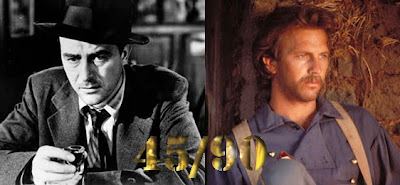
Best Pictures: Dances With Wolves & The Lost Weekend

It's been nearly six months since the last episode of the tri-blog series Best Pictures From the Outside In. At this rate we'll be done in 2021! Literally. "Stay tuned!!!" Nevertheless we're finally back with a new installment pairing 1990's Dances With Wolves & 1945's The Lost Weekend.

and comment on that discussion there.

Since those conversations are rarely about the Oscar field but just the winners, I thought I'd share a few quick words on 1990 and 1945 right here. I've noticed in my own lists over the years that the further back in time I go the more I agree with Oscar's choices. I'm guessing this is not a case of Oscar once having better taste (i.e. mine - haha) but simple math. I've seen more films from the modern era so the chance of disagreeing grows. For instance, Oscar's best picture field for 1990 was composed of...
  • Awakenings
  • Dances With Wolves
  • Ghost
  • The Godfather Part III
  • Goodfellas
Which was almost nothing like my list at the time (though I hadn't seen Goodfellas) which went like so back in the day...
  • Edward Scissorhands *winner*
  • Ghost
  • The Grifters
  • Longtime Companion
  • Postcards From the Edge
I'm not sure I could stand by the Ghost cheese 20 years later or Longtime Companion (I don't remember it well) but the other three have had staying power in my brain and in movie culture, too.

My decrepit ancient copy of Inside Oscar is filled with color markings -- I once used the book to track my film viewing. Certain years have highlight markings all over the film titles. The 40s are my weakest decade but strangely 1945 is all marked up. I'd rank the Best Picture nominees like so
  1. Mildred Pierce (Such a goodie. Watch it before the Kate Winslet remake arrives)
  2. Spellbound
  3. Anchors Aweigh
  4. The Lost Weekend
  5. The Bells of St. Marys (the first sequel nominated for Best Picture and the only BP nominee from '45 that I haven't seen. But I didn't really care for Going My Way so I'm in no rush)
I love those first three so I'm fine with Oscar's list. But is that because I've seen so little else from '45? I wonder, if I saw 100 films from each film year before my time, would my taste rarely align with Oscar's? Have you ever wondered about the same thing? A "yes" answer means hidden gems and new favorites await you in every single film year should you only start to look for them.

Now, read our boozy bender with Kevin Costner over at Nick's Flick Picks.
*
*

Wednesday, June 09, 2010

Donald Duck is 76

Do you prefer "Daffy" or "Donald"? I can't say I've ever been much of a fan of either of the famous Ducks (maybe Howard, briefly, in the 80s). Maybe sea fowl just aren't my thing? I was, however, totally into Chip & Dale (and chipmunks) as a child. So here's seven minutes of funny Toy Tinkers (Best Animated Short Film Nominee, 1949) starring all three to start your morning:


Here's a list of the ten best Donald Duck cartoons from a real fan. And if you've never seen Donald's only Oscar-winning short, Der Fuehrer's Face (1942) you can watch it on YouTube.

The Disney and Warner Bros characters used to get Oscar nominated a lot in the Animated Short category. In the past couple of decades the closest thing we have to a perennial in that category is Wallace & Gromit or Pixar as a studio, if that counts, though their characters don't repeat.

You know what I think is a crying shame as animated short films go? That Who Framed Roger Rabbit (1988) didn't really become a franchise. Disney made three short films with the characters after that blockbuster hit: Tummy Trouble, Rollercoaster Rabbit and Trail Mix-Up though none were nominated at the Oscars. They had the misfortune of arriving in that stretch of a dozen years or so when there were never more than 3 nominees in that category.
*

Sunday, May 16, 2010

A Wonderful Pair

Gene: ohhhh 'Shortcut Suzy.'
Rita: ohhhh 'Hard Way Maguire'...
......We're a fine pair.
Gene: A wonderful pair.
Rita: Aren't we, though?
Cover Girl (1944), Rita Hayworth, Gene Kelly

Friday, February 26, 2010

Link You, Link Me; Link It Together, Naturally

All Things Fangirl how traditionally trained our Oscar's acting nominees? This is hot. Yay, for new coverage angles.
Towleroad My latest column: Prodigal Sons has opened (finally!) so watch for it in your city. Plus, a few more words from my Lee Daniels (Precious) interview and Kathryn Bigelow's enviable man harem.
Movies Kick Ass Jose unveils his "best of '09"
The Critical Condition helps you win your Oscar pool with the live action and animated shorts
Cinematical "How open are you moviewise?" That's a good question. We like to think all of Film Experience's readers are wide open
I Need My Fix Angelina Jolie is 'Pretty in Paris' filming The Tourist
Pop Watch post Olympic competition, Johnny Weir continues to be awesome. Speaks out for all future girlyboys. Someone give him a medal, now please.
i09 With Dollhouse wrapped, what's next for Eliza Dushku on the bigscreen?

C'est La Gêne (in French) Who is the greatest actress in the world?


Elle s'appelle Nicole Kidman
, n'est-ce pas?
Awards Daily Have you been following this whole Chartier mini-scandal?
Nick's Flick Picks YAY. Another year of Nick's Actress Project, 1944. The passage about Ingrid Bergman = Nicole Kidman is especially divine/interesting

BBC News the Olivier Award nominees over in London (home to an ever thriving theater culture) are like a laundry list of people we'd like to see in better movie roles and maybe during future Oscar seasons. Gillian Anderson, Jude Law (i.e. New Hamlet), James McAvoy, Rachel Weisz and Keira Knightley are the most famous ones. But there's still more enticements. Imelda Staunton, Eddie Redmayne, and remember Samuel West who was so bookishly bewitched bothered and bewildered by Helena Bonham-Carter's inner fire in Howards End) and Mark Rylance who, for a brief period was a go to guy for frequently naked dramas (Angels & Insects, Prospero's Books, Intimacy)? They're all nominated. What a group. Makes you want to book a longish trip to London and attend lots of shows.