Showing posts with label Screen Queens. Show all posts

Monday, December 21, 2009

Screen Queens: Best of the Gay Aughts

MattCanada here with a bit of an overview and Best-Of Gay films for the last decade.

Gay cinema over the last ten years has been intrinsically tied to both the political gains made by gay activists and the intense battles surrounding everything from the worldwide fight for gay marriage to nationally specific issues like America's DADT and DOMA, and Britain's repeal of Section 28. The relationship between the political and the cinematic is always most pronounced in the medium's relationship to minority groups and their texts.

The Aughts have seen gay-rights become the most visible"social values" issue in America, and this has been reflected in a number of high profile American films dealing frankly, sexually, and politically with what it means to be gay in America. Milk, Far From Heaven, and Mysterious Skin employ gay filmmaking traditions, like those of Affirmation Documentaries (Richard Dyer's term), Sirkian melodrama, and New Queer Cinema, to examine the complexity of gay male American history.

Brokeback Mountain
, in terms of cultural and critical impact, deserves to be in a category all its own. It is the defining film in the gay canon, one that has become The Gay Film to which everything else, before or since, is compared. Its mainstream success can be partially attributed to its de-gaying through the clever marketing technique of calling it a 'universal love story'. However, without a doubt, it lost the Oscar as a result of latent homophobia within what is generally perceived to be the liberal media elite. All in all, the visibility of male homosexuality in American cinema over the last decade seemed at an all time high.
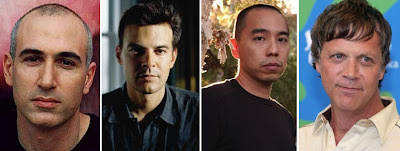
a small sampling of important gay auteurs in the Aughts:
Eytan Fox, François Ozon, "Joe" Weerasethakul and Todd Haynes


Internationally gay film has continued to flourish, especially with the arthouse approved gay auteurs, the most notable being Pedro Almodóvar, Francois Ozon, Eytan Fox, Apichatpong Weerasethakul, and Brillante Mendoza. For me personally the biggest joy has been watching Quebec, or maybe more appropriately Montreal, become a mecca for intelligent, entertaining, and daring gay filmmaking, especially Jean-Marc Vallee's C.R.A.Z.Y, and Xavier Dolan's I Killed My Mother. English language Canada has not had the same high-profile successes, but has continued to see good work from the always intelligent and challenging John Greyson, as well as provocateur Bruce LaBruce.

Documentary cinema has continued to be an area where a multitude of disparate perspectives on gay life can be presented, and Paragraph 175, Tarnation (mentioned in an amazing post here the other day), Camp Out, Small Town Gay Bar, A Jihad For Love, For the Bible Told Me So, and Outrage have been a few of the breakout examples.

Finally, Latter Days and Shelter (previous post) have been two noteworthy gay film fest hits that became big successes within the gay community this decade. Their rankings at number 3 and 2 respectively on AfterElton.com's 50 Best Gay Films Ever speaks to this popularity, and while I can respect the latter, I think the former is just about the worst gay film I have ever seen.

So, here are my personal top 10 of the last decade:

10 Noah's Arc: Jumping the Broom
Gay cinema is dominated by white men, white stars, and white standards of beauty. That is why it is great to see a film dealing with issues surrounding African-American gays and their different positioning within straight hegemony and dominant (re: white) gay culture. Hopefully this film's success will spur gay cinema to be more inclusive and ethnically pluralistic. This film is a lot of fun and provides a great showcase for a very talented cast.

09 Before Night Falls
Javier Bardem plays gay! Johnny Depp does drag!

08 I Killed My Mother
Innovative debut by Montrealer Xavier Dolan who at 18 astoundingly wrote, produced, starred in, and directed this film. There are flaws, but everything is worth it for the film's stylistic flourishes and the lead performance by Anne Dorval. (full review)

07 For the Bible Tells Me So
One of the best documentaries of the decade, and crucial viewing for anyone who wants to understand the intersection of Christianity and homosexuality.

06 Mysterious Skin
Gregg Araki is the most original and iconoclastic gay director of the last twenty years, and Mysterious Skin is his most accomplished work: nuanced, daring, and heartbreaking.

05 C.R.A.Z.Y.
The best growing up and coming out story I can remember, and the greatest use of a David Bowie song ever. Everything about this film works, and the soundtrack is incredible.


04 The films of Pedro Almodóvar
My favorite director made four films this decade and although only Bad Education (2004) was specifically gay, everything he does affects and is affected by gay cinema. I think he is now officially the most important gay auteur of all time.

03 Brokeback Mountain
Beautiful, iconic, and flawless.

02 Far From Heaven
Todd Haynes revisionist homage to the films of Douglas Sirk is masterful filmmaking, and it might even surpass the lofty heights of All That Heaven Allows (1955). Julianne Moore's lead performance is the best of the decade. How she lost the Oscar is beyond me.

01 Milk
I don't know where to begin... so much to love. The cast is magnificent, the editing is peerless, and no film dealt so explicitly with the issues facing gay people worldwide as this did. A perfectly made political film that uses the traits and tropes of the biopic to interrogate homophobia and cogently argue the needs and desires of the gay community.


Hope everyone enjoyed this list. What are your personal picks for best (and worst) gay films of the last decade?
*

Monday, December 14, 2009

Screen Queens: Indie Romance

MattCanada here with another week of gay cinema. In many ways Trick is the perfect companion film to last week's entry My Best Friend's Wedding because it explores similar themes, the search for Mr. Right and the gay man-straight female friendship, but this time from the other perspective- that of the gay male

Trick is one of my favorite films of the nineties, and pretty much the perfect gay romantic comedy. At the core of the film is the relationship between struggling musical theatre writer Gabriel (Christian Campbell) and Go-Go Boy Mark (John Paul Pitoc), after a chance meeting on the subway. The dynamic between these two has a truthfulness to it and is thoroughly seducing. As they search the city for somewhere to hook up, what develops is sensitive and romantic. The believable grounding chemistry of Mark and Gabe allows for the excess of virtually everything surrounding them, especially the over the top supporting characters.

The pick up scene on the subway is characteristic of the film's naturalistic approach when it comes to the future lovers. The camera holds focus on Gabe looking at a sleeping Mark, and it cuts from his gazing face to point of view shots as he looks up Mark's Adonis-like body. He then gets caught staring by a fellow subway patron and quickly averts his eyes, only to have his gaze slowly brought back to sleeping Mark. While looking Mark opens his eyes and makes direct eye contact with Gabe, who nervously looks away.


This whole sequence is done brilliantly. The tension of looking is conveyed perfectly, as well as the reality that there is something at stake. In essence, that in gazing (homo)sexually so publicly there are potential fruits, but also inherent dangers. The balance between Gabe's reticence, especially when met with an acknowledging look, and the steadfastness of his scopophilia captures the essence of cruising and makes it cinematic. It is because of moments like these that the film remains grounded while introducing less realist events and more excessive characters.

The primary of these excess is Tori Spelling's Katherine, the gay best friend and aspiring actress/singer/superstar. Her performance is such a revelation (although I must admit I loved her as Donna in 90210). The friendship between Katherine and Gabe is extremely close, but unlike My Best Friend's Wedding, it is not idealised or viewed in any way as a substitute or makeup for a sexual/romantic union. Katherine is larger than life, and Spelling is always noticeably performing the grandness and theatricality of her character. She has two standout moments which are highlights of the film. First, her rendition of Gabe's song "Enter You" for a musical theatre workshop brings new meaning to the word camp.


Katherine's singing is vocally atrocious, but as a piece of performance it is showstopping. The there's the final Katherine sequence wherein she crashes Gabe and Mike's post-makeup date. It's hilarious, insane, and touching. "Why can't you be straight?", she asks revealing her love for her gay-BFF. The friendship between the two is shown as central to both, but essentially problematic because of the non-reciprocal feelings.

The film has many other joys, especially drag queen Miss Coco Peru's jealous monologue and Steve Hayes' musical theatre aficionado Perry (interesting side note is that Mr. Hayes now does a youtube series called Tired Old Queen at the Movies). Each are given extended scenes to perform and showcase their talent, and these narrative detours are jewels.

It's an interesting film to view in relation to My Best Friend's Wedding, and ultimately it's the indie Trick which is the more traditional "romantic comedy"; sidelining the de-sexualised best friend, focusing on the romantic couple, and featuring heroes which are immensely likable. Trick is a movie which manages to be both realistic and camp at once, and this careful balancing act makes the film a delight.
*

Saturday, December 05, 2009

Screen Queens: Julia and Rupert

MattCanada here with another week of gay cinema. This week's film is My Best Friend's Wedding, one of the most criminally underrated films of all time and, in my opinion, the best comedy of the nineties.


From afar the film's gay credentials seem to amount to just another example of the romantic comedy's stereotypical use of the gay best friend character. However, George (Rupert Everett in a career best performance) is the film's voice-of reason, moral centre, and ultimately the film's unconventional leading man.

The friendship between George and Julianne (Julia Roberts) highlights the special and unique relationship gay men and women can have. In gay film critic (and personal hero) Robin Wood's words
George's maturity, considerateness, and tact are intimately connected to the gayness that sets him apart from social norms, permitting him a wise distance from the practices and conventions in which those around him are entangled
Throughout the film Julianne has two defining men in her life, the mostly absent Michael (Dermot Mulroney) who is her past and George "her best friend these days" who is her present and her future. The final sequence has George surprising Julianne at the titular wedding. She has given up Michael, said goodbye to him for good.

The ending, however, is not sad, very much the opposite. As Julianne and the camera search out George in the crowd of people, the tone shifts from one of melancholy to happiness. The crowd parts, and there is George, as debonair as any leading man, and Julianne every bit the beautiful and independent leading lady. Julianne and George's dance reunion is constructed like any classic happy ending, the only difference being the Happy Couple is not the heterosexual couple but best friends, one gay and one straight.

George's final line...
Maybe there won't be marriage.
Maybe there won't be sex...
But by god there will be dancing.
...is transgressive in its acceptance and extollation of a non-normative union (for mainstream Hollywood, at least). The couple dance off happily, as the singer sings "forever and ever". Here the gay man is not relegated to homosexual pet status, he is the leading man, the moral centre of the film, and ultimately its hero. The relationship between Julianne and George is one of equals, and the film celebrates that at its conclusion.

The relationship between George and Julianne is only one of the many loveable aspects of My Best Friend's Wedding. Julia, Rupert, Dermot and Cameron Diaz all give performances that could be considered either their best work or on par with it. The script is hilarious and its set pieces are endlessly re-watchable. The Karaoke Scene where Julianne forces a reticent and stage shy Kimberly (Diaz) onstage to humiliate her, only to have it backfire and endear her to Michael and the whole room is poetic justice at its finest. Another exemplary comedic sequence is the cat fight in the washroom where Kimberly finally lets Julianne have it. Though indisputably the best moment is the now iconic "I Say A Little Prayer for You" wedding party sing-a-long led by George and the two slutty Southern cousins (this song also accompanies Julianne and George's dance at film's end). Movie moments which deliver pure and perfect pleasure are few and far between, and this is one of them. From the harmonizing, to Julianne's embarrassment, and the ensemble acting work, everything comes together flawlessly for a few minutes of cinematic joy.


Finally, isn't it amazing that a romantic comedy has at its center a character who is flawed and who makes mistakes but is not defined by them? Julianne is complex and Julia Robert confidently makes her both likable and enraging. If it was up to me the film, screenplay, Julia, Cameron, and Rupert all would have been nominated for Oscars that year.

Am I in the minority for finding My Best Friend's Wedding completely brilliant and under appreciated? Are there any other romantic comedies which people think were overlooked because of their connection to the most critically reviled genre?

Saturday, November 21, 2009

Screen Queens: Hollywood Does AIDS

Hi everyone, MattCanada here with another weekly dose of gay cinema. This week we're looking at Philadelphia, the Oscar winning courtroom drama, essentially the defining Hollywood response to the AIDS epidemic.


I first saw this film as a kid. I must have been about seven when I watched it with my parents and it was definitely my, and probably many other people's, introduction to AIDS. For me it continues to shape how I think about the virus, the stigma, and the epidemic. Longtime Companion opened a few years earlier but this was the first mainstream prestige film to deal with AIDS and homophobia. Having two big stars in Tom Hanks and Denzel Washington must have seemed like a big step for Hollywood. All of this is well and good, but rewatching the film for the first time in over a decade, I had serious problems with its filmic construction and especially its politics. While it remains important for being 'the mainstream gay AIDS movie', the film has definitely not aged well.

The Major problem is with the Denzel Washington character, Joe Miller. Joe acts as a guide for the straight audience into the scary world of gay-ness. His arc from homophobic to mildly understanding is shown as a victory, and it is Joe, not Hanks's Andrew, who goes through a pivotal transformation. He is the true hero of the film: not only does he save the gay victim, he grows as a person, thus giving the audience someone to root for. But this leaves Tom Hanks' gay character at a mediated distance where he can be sympathised with (or pitied depending how you see it). This film was made at a different time in both Straight society's relationship to homosexuality and the mainstream gay community's stance towards the oppressions and exclusions of straight hegemony. Today, the politics seem conservative and even condescending, positioning gay men as victims needing to be rescued and protected by the good straights from the bad straights. Contemporaneous films from New Queer Cinema, especially Derek Jarman's Blue, Gregg Araki's The Living End and John Greyson's Patient Zero, are much more relevant now for an understanding of the AIDS epidemic, and the anger and response of the gay community. Philadelphia is a film from another time in mainstream culture and it's unable to transcend its dated approach and politics.

The other problems are minor in comparison. Tom Hanks doesn't give a particularly remarkable performance (in my opinion it was the weakest of that year's Best Actor nominees). It may have been a brave choice of role and a good performance, but it's not on par with other AIDS performances (Steve Buscemi in Parting Glances, the cast of Angels in America, Penélope Cruz and Toni Canto in All About My Mother).


Jonathan Demme's directing also overreaches at points, especially the Opera set piece and the courtroom scenes with canted camera angles. Demme is at his best when he keeps his stylistic flourishes to a minimum. The strength of his classics, namely The Silence of the Lambs and Married to the Mob, is the seeming simplicity of his directing, which allows for pitch perfect performances, flawless narrative progression, and a complex and inventive intermingling and subversion of genre. Philadelphia is too fussy, especially in the moments when we are most required to empathize with the characters.

There are incredible parts of Philadelphia though. The performances of Mary Steenburgen, Antonio Banderas, and Joanne Woodward are all fantastic. Mary in particular, I think, deserved a Supporting nod for transforming a one dimensional role into something memorable.

There are also two sequences in the film which are incredibly moving and show Demme at his musical best: the opening credits sequence with Bruce Springsteen's "The Streets of Philadelphia" and the closing home video section with Neil Young's "Philadelphia" overlayed. Both sequences are so simple, yet the combination of music and expressive imagery are perfect distillations of the humanity of people with HIV and AIDS. For those two sequences alone I think the film deserves to be watched and remembered.


Bruce Springsteen takes those Streets of Philadelphia to an Oscar win

I would love to hear your thoughts on Philadelphia. I'm interested to know if people remember what the discussions surrounding the film were like on its original release? Was Tom Hanks' win one of those inevitable Helen Mirren/The Queen steamrollers or more of a surprise?

Sunday, November 08, 2009

Screen Queens: Sally Bowles

MattCanada here with another week of homo classics. Since I started writing this weekly column about a month ago, I have focused on films which have not been Oscar contenders and not featured the actresses which Nathaniel, me, and all the readers of this website respect (read: worship in a cult-like fashion). So on to Cabaret!


Liza Minnelli's Oscar winning role as Sally Bowles may well be the gayest Oscar win of all time. Now I am not a big Liza fan, actually I actively dislike her in anything else, but in Cabaret she gives one of the most amazing performances in the history of cinema in the greatest movie musical of all time. Not to be hyperbolic or anything, but Liza's Sally and Cabaret are earth shatteringly good. Liza is hardly the only reason to love Cabaret. You can get almost as much pleasure out of Joel Grey and Marisa Berenson's performances, as well as Michael York's Dietrich-esque bone structure. The Kander and Ebb songs are musical standards by which all other songs should be judged, and Bob Fosse's direction is flawless and endlessly inventive. The costume design, art direction, cinematography and editing are all incredible*. All of this make Cabaret one of those rare films where all of its components brilliantly fit together.

There are two recent Oscar wins that I want to compare to Cabaret and for different reasons. The first is the Best Picture win for Chicago. The film takes so much from Cabaret that it would be inconceivable visually without its superior precedent. The most blatant rip-off (or homage depending on how you see it) is "When You're Good to Mama" complete with the dancing behind the curtains from the end of Sally and The Host's performance of "Money Makes The World Go Round".

"Money Makes the World Good to Mama"

Both films are based on Kander and Ebb musicals, and therefore they have similarities which evince the auteurist credentials of the songwriter and lyricist. To a certain extent the seminal importance of Cabaret makes it unavoidable for Chicago to heavily reference it, but the visual similarities from Marshall's to Fosse's film are there. Chicago's Best Picture win, and its heralding of the return of the musical, can in many ways be seen as a celebration of Cabaret's brilliance.

The second recent Oscar win for which Cabaret provides a useful comparison is Jennifer Hudson's Best Supporting Actress win for Dreamgirls. Liza Minnelli's performance is musically flawless and provides two showstopping moments, the Torch Song "Maybe This Time" and the iconic closer "Cabaret". Jennifer Hudson's performance in Dreamgirls is musically astounding and her rendition of "And I Am Telling You (I Am Not Going)" is the highlight of the film. However, the difference lies in the performances which surround these musical moments. While Liza combines comedy, melodrama, and pathos in the service of conveying the the complex range of human emotions, Hudson can barely deliver her lines in character. Hudson deserved a Grammy, a performance like Liza's deserves the Oscar.

<--- 'beedle dee dee dee dee, Two Ladies': Michael York and Helmut Griem

Cabaret
and Liza's Sally have become an ineluctable part of gay culture. Cabaret is the first critical and commercial success to deal with homosexuality in an understanding and mature fashion, making it a part of the texture of the film.

Its importance for the post-Liberation gay community of the Seventies I can only guess, but its continued reverence in gay culture would indicate that it was pretty important. Recently Kristin Chenowith performed "Maybe This Time" on Glee, showing the continued cultural cachet of Cabaret and its appeal to a gay audience (Glee + Chenowith + Cabaret is as camp as it gets).


"Maybe This Time" through the years. With Kristin Chenowith, Liza
Minnelli and Natasha Richardson

While most Oscar wins for Actors playing gay characters are solemn and maudlin enough to make a funeral or Senate Hearing seem enjoyable, Liza brings humour and gravitas to a performance which is a highlight of gay cinema and the pantheon of Best Actress winners.

Lady Lucky: Liza won the competitive Oscar that had always eluded
her legendary mother Judy Garland 'The World's Greatest Entertainer'


*Editors note: Cabaret holds the record of the most awarded movie to have ever lost Best Picture (the 1972 winner was The Godfather) winning an incredible eight Oscars, including three of the big six. Strangely, it was not nominated for costume design. Star Wars and A Place in the Sun are the runners up with six Oscars each.
*

Sunday, November 01, 2009

Screen Queens: Another Country

Hey, MattCanada here with this weeks queer cinema post. I finally got around to watching Another Country. It was not what I expected at all and this did affect how much I liked the film. My expectations going into the movie were of a spy thriller with a hefty dose of gay sex, not PG fondling. What I was confronted with was a drama which explores the British class system through the study of Guy Bennett's (fictionalised Guy Burgess) disenfranchisement from his class because of his homosexuality at an unnamed Boys Public School (read: super posh). The film is beautifully shot, wonderfully acted, and intelligently written - a Merchant Ivory film in everything but name.

Rupert Everett in his star-making role (first on stage, then on screen)

The lead actors are all strong, especially Rupert Everett's flamboyant toff Guy Bennett. Everett does not overplay him which is a surprise given the actor's subsequent career. For Bennett he finds the perfect balance of class and performative gayness. Though the routines and affected speech of all the schoolboys would have to be classified as dandy-ish, Everett's pushes Bennett to be a little more excessive. There are times, during the cricket games and the military role calls, where his flamboyance will not be contained by the masculine structures of the ceremony, and this is what is eventually so reviled by the prefects. That is to say, it is his indiscretion and public acknowledgement/celebration of his homosexuality which is contemptible, not the actual act of having sex with men. Most of the other boys engage with other men sexually in lieu of female company, but it is not talked about, made public, or acknowledged as enjoyable. Also great are Colin Firth (in his screen debut) as the idealistic Marxist Tommy Judd who veers between petulant and intrepid, and the fascistic Fowler played brilliantly by Tristan Oliver.

Cary Elwes in his film debut (unless you count a bit as "disco dancer")

The look of the film is beautiful, and I'm not just talking about the male leads (although Cary Elwes might be prettier here than the Art Direction). The boarding school, which has many similarities to Eton, is a perfect expression of the other country in which the privileged live. The lush cinematography (Peter Biziou was honored for this work at Cannes) and meticulate costume and set design construct a world that is totally foreign to the vast majority of spectators, and allows the audience to understand how Guy's alienation from this privilege, because of his homosexuality, is enough to turn him towards espionage and treason. When Judd says: "All problems solved, no commies and no queers", he is circumscribing what is unacceptable and what blocks these men from attaining the power they were born to posses, and expresses how alienation and oppression made them bedfellows.

Colin Firth (in his film debut) as "Judd" and Rupert Everett as "Bennett"

[photo src] Everett & Kenneth Branagh in the West End production, 82.
Guess who played the roles in 83? Daniel Day-Lewis (!) and Colin Firth


The script, adapted by Julian Mitchell from his own Laurence Olivier Award-winning play, is nuanced, intelligent, witty and provides a great closing line (featured in F&L a few weeks ago).

Despite everything positive I have to say about the film, and what a fine achievement I think Another Country is, I didn't love it. Maybe I did just want a sex filled spy thriller with double crosses. I'll have to watch it again to really appreciate all the complexities of the script, and beauty of the mise-en-scene. For now I will recommend it, but caution people against expecting a 1930s gay Bond.

Does it make me a bad movie lover for wanting a bit more sex, and some Ian Fleming-style intrigue?


*

Saturday, October 24, 2009

Screen Queens: Hammer Horror

Hi, Matt here with your weekly dose of Queer Cinema. With Halloween coming up, we turn our focus to horror.


Hammer Horror films are not truly part of the gay canon, and as a body of films they are conservative in their narrative arcs and messages. However, I've always been a huge fan. They are undeniably camp and always feature either subtle homoeroticism or full on Lesbian Vampires. For those unfamiliar with this horror subgenre, it is a collection of films produced by Hammer Film Studios from the late 50s to early 70s that mixed Gothic melodrama with exploitation horror. The studio was most famous for their vampire, mummy, Frankenstein, and cave girl pictures.

The vampire films stand head and shoulders above the rest. Hammer's Vampires went through two major cycles, the gothic Dracula films with Christopher Lee and the later sexploitation-y lesbian vampire films. The early Hammer films are the most respectable. The closer you get to the seventies, the trashier and campier the films become. Obviously the later ones are my favorites! Two representative films from each cycle are the Dracula Has Risen From The Grave (1968) and the girls boarding school set Lust for A Vampire (1971).

Dracula Has Risen From The Grave
has Dracula being resurrected accidentally by a cowardly, wayward priest who becomes the dark prince's slave. Dracula returns to his castle only to find it has been exorcised by the Monsignor. He goes off in search of the Monsignor's virginal niece to corrupt and bring her over to the dark side.

The film's camp is off the charts, with heaving bosoms, fake blood, and Dracula's potent sexual allure entrapping men, women, and......virgins. Dracula's blood shot eyes are supposed to signify his evil, but they really just look like he's smoked alot of weed before going out cruising.


Lee's relationship with his slave priest has elements of S&M, while the virginal Maria is only too happy to trade in her virtue for some dark and steamy vampire sex. The film might end reaffirming the superiority of heterosexual monogamy, but it has too much fun showing all the transgressive sexuality embodied by Dracula to be effective. The overacting, melodramatic plots, kitchy sets, and costumes all add to the fun, making the film as campy as Mommie Dearest. The director uses endless coloured filters, making sections seem like a Gothic acid trip. While it has an overlong prologue, the film is really fun and has a lot to offer the gay spectator, not the least of which is Christopher Lee's dominant Dracula.

Lust for A Vampire is loosely based on Sheridan le Fanu's archetypal lesbian vampire novella Carmilla (1872). The film has the Karnstein family resurrect the buxom Carmilla Karnstein in order to enroll her in an all-girls boarding school for the sole purpose of allowing her maximum access to dishy young virgins. This film's camp is exponentially higher than the Lee films, because the whole point of this film is seeing a minxy vampire seduce anyone who makes eye contact with her (literally).

There are plenty of girl-on-girl massages, blood soaked breasts, and over dramatic declarations of love and lust to keep even the most jaded cult fan interested. The acting is dreadful, the dialogue is worse, but the look (sets, costumes, cast, and again use of filters) is beautiful, in that iconic Hammer Horror style. There are so many incredible moments. Richard's dream sequence is amazingly kaleidoscopic in its use of fade-outs, dayglo filters, psychedelic music, and sex-and-gore images.


Another key scene is the resurrection of Carmilla where a virgin's blood makes her materialise naked and blood soaked. Any of the lesbian sequences or spontaneous declarations of love (my count: 4) are worth the price of a rental. It's possibly the trashiest and most enjoyable of the entire Hammer oeuvre and not to be missed.

These films have so much to offer a spectator who relishes camp, and their explorations of non-normative sexualities (regardless of their ultimate affirmations of heterosexual monogamy) make them important and enjoyable members of the Queer Horror cannon. Other late greats are Taste the Blood of Dracula (1969), The Vampire Lovers (1970), Dracula A.D. 1972 (1972), and the mummy film Blood from the Mummy's Tomb (1971).


Kate Bush pays tribute in the amazing song Hammer Horror

Does anyone have any other favourite gay or gay-ish horror films for us to enjoy over Halloween?
*

Saturday, October 17, 2009

Screen Queens: Paris Is Burning

Matt Canada here with another edition of "Screen Queens". Last week we looked at To Wong Foo, a mainstream lighthearted approach to drag queens and their fab subculture. So this week, a more realistic, nuanced, and sensitive approach to the same subject. Jennie Livingston's seminal documentary Paris Is Burning is a film I have been trying to find for years now, and it more than lives up to its reputation.


The film examines New Yorks mainly black and latino ball subculture, in which groups of queens, termed Houses (ex. House of Labeija, House of Xtravaganza), compete for prizes in categories like 'Realness' (most able to pass in the straight world), 'Pretty Girl', 'High Fashion Winter Sportswear', 'Miss Cheesecake', and 'Town and Country' to name just a few. Livingston's camera explores the lives of the different types of members within these Houses: famed drag queen Dorian Corey; House 'Mothers' Anji Xtravaganza, Wili Ninja and Pepper Labeija; young and beautiful transgender women Octavia St. Laurent; and gay men like Andre Christian. The documentary details the slang, rituals, and harsh behind the scenes realities of the balls, focusing partly on the hustling and stealing it takes many people to survive and still look glamorous for the ball runways. However, most importantly the film explores how this specific group of disadvantaged people has responded to oppression.

Paris Is Burning is a defining film of early 90's New Queer Cinema, and it stands virtually alone amongst the classics of this collection of texts, as a film which deals with ethnic/non-white gay culture. The only other contemporaneous film I can think of which deals with gay minorities is Isaac Julian's Looking for Langston (1989). There have been some -- notably bell hooks -- who have critiqued its counter-cultural position and non-white address because it was authored by a white women, but I don't think this line of thinking enriches any discussion, appreciation, or understanding of the film. Livingston focuses on the disadvantages of the combination of race and sexuality and therefore exposes the inequalities inherent in society at large, as well as a gay movement which purports to speak for everyone. The black and latino drag queens and transgendered women are viewed as excluded not only from straight society, but also from the predominantly white gay culture. The non-whiteness and queerness of the ballers excludes them from any substantive form of power, fame, success, and money. The balls then act as a means of appropriating, claiming, and legitimising the right of this group to success and wealth.

In the words of Dorian Corey (pictured)
In real life you can't get a job as an executive, unless you have the educational background and the opportunity. Now the fact that you are not an executive is merely because of the social standing of life....black people have a hard time getting anywhere, and those that do are usually straight. In a ball room you can be anything you want, you're not really an executive, you're looking like one, and you are showing the straight world 'I can be an executive. If I had the opportunity I could be one because I can look like one', and that is a fulfillment.
This really sums up Paris Is Burning's raison d'etre: showing how ball culture responds to and resists domination and oppressions of the mainstream.

The film is incredibly complex, yet endlessly enjoyable. The costumes, cattiness, wit, and excess of Hollywood's representations of drag culture are present in spades in Livingston's documentary. However, the director and her subjects situate these characteristics beside the reasons for why they have developed and the functions they serve. By placing the realities beside the glamour and the realness, the viewer enjoys the camp while critiquing the systematic oppression.


This is one of the best documentaries I have ever seen. It's exciting to see how much this film has to say and how exquisitely it says it. Also, on an Oscar note, apparently there was outrage when it failed to secure a Best Documentary nomination... Scandal!

[Nathaniel's note: Matt's right. I remember this scandal well. Though IMDB lists Paris is Burning as a 1990 film, it was released in 1991 and became a major arthouse hit earning nearly $4 million at the US box office. That's a lot of $ for a gay documentary at the box office. It wasn't the only high profile snub for documentary that Oscar year either. Two very famous showbiz docs, Madonna's frisky tour diaries Truth or Dare and the behind-the-scenes-with-Coppola doc Hearts of Darkness: A Filmmaker's Apocalypse were also snubbed. Here's an old article from EW on the controversy. It was written by none other than Jeffrey Wells.]

What do you readers think of this movie and its relation to more mainstream and lighthearted depictions of drag culture?

Paris is Burning
is available for purchase on Amazon and for rental on Netflix, Blockbuster and GreenCine
*

Saturday, October 10, 2009

Screen Queens

Hi, Matt Canada here with a weekly column looking back at gay cinema classics. I think that alot of people, gay and straight alike, view gay films as formally, thematically, and socially ghettoised and sub par. It is my goal that this column will reflect the diversity, breadth, and quality of the gay canon. This body of films encompasses everything from those made by gay filmmakers dealing explicitly with gay issues (Milk); to gay authored films that are nominally straight stories, but are interpreted by many as allegorically commenting on Lavender themes (George Cukor's Rich and Famous); camp classics (Mommie Dearest); gay films authored by heterosexual directors, screenwriters and/or producers (Brokeback Mountain); and those "heterosexual films" that have always been appropriated by gay audiences as queer (All About Eve). With such a wide array of possible films to look at, this column will bring something unique to the table each weekend.

First up is Beeban Kidron's Too Wong Foo Thanks for Everything, Julie Newmar (1995) starring Patrick Swayze, Wesley Snipes, and John Leguizamo as drag queens. The story of three drag queens on a road trip across the less metropolitan wilds of the country's interior, where there's a breakdown which subsequently forces interactions with less refined locals, was not a very novel idea the year after the success of The Adventures of Priscilla, Queen of the Desert. It has long been derided as a bad American remake of said film. However, when I first saw this film at around eight or nine (oblivious to my sexuality), I had never heard of Priscilla and loved the film's campness, lavish frocks, sequins, smiles and happy ending. Even as I grew up and my tastes matured, I continued to love everything about the film. It was practically the only gay themed film I watched in my adolescence with straight friends and family. They loved it. I loved it. It was one of the only positive and shared experiences of gay culture as a closeted youth.

So that is all well and good, but now that I have an honours Film degree and a dissertation on gay cinema behind me, bitchy humour, cocks in frocks, and a happy ending can't still have the same effect, right?

...I am not going to lie, I was almost embarrassed by how much I still loved it. Do not get me wrong, I did realise its faults on this viewing: including but not limited to the completely unbelievable script, desexualized gay men, condescending attitude towards women, and deus ex machina conclusion. However, I still find the film immensely enjoyable. The three stars as drag queens are great and obviously having loads of fun. They have everything you want from celluloid female impersonators: over-acting, bitchy one-liners, and an innate campness. However, the relationships between the three queens and especially the relationship between Swayze's Grand Dame and Stockard Channing's battered-housewife carry some real emotional weight and are expertly acted, if not flawlessly written.

The film is not perfect but it is a definitely more than a Priscilla rip-off. I think it deserves some revisiting. As some English queens say - it's camp as tits - and I love it.
*